Welcome to Della Galton’s website

Author: Della Galton

How to Write Your First Novel – Sat 17 May

Just a very quick blog to say I’m running a day course – How to Write Your First Novel. It’s at Kinson Community Centre, Bournemouth on Saturday 17 May from 10.00 a.m. to 4.00 p.m.

It should be a small group so quite intimate and fun.

We will look at the following aspects of writing a novel:

  • Do you have a big enough storyline?
  • Does your plot keep the reader guessing?
  • How do you create irresistible characters and settings?
  • How do you write that all important first page?

Don’t worry, I won’t be asking you to reveal any brilliant plots you may have in mind!

Is the course for you?

This course is aimed at students who are thinking of writing or have started their first novel. It is workshop based and you will get the chance to read out your work and gain constructive feedback.

Please email me if you’d like to book. Thank you.

While I’m here – can I just mention my novella, Meltwater, is on promotion this bank holiday weekend, just 99p, click here for more details.


Woman’s Weekly Fiction Workshops – Hot Tips

A couple of Fridays ago I was teaching again with Gaynor Davies at the Blue Fin Buildings, our subject, Writing Short Stories for Woman’s Weekly. I thought you might like an update. There are two more short story workshops planned at IPC, by the way, 15 August and 1st September 2014, click here for more details and as they are so popular I’m also in discussion with Gaynor about doing another one this year, probably in October. So don’t worry if you can’t get to one of these.

In the meantime for those who can’t make a workshop, here are a few tips from myself and Gaynor hot off the press. I must point out these are my tips, as I understand them, not direct quotes from Gaynor. (Just in case any of the Woman’s Weekly team are reading).

  • When Woman’s Weekly first came out their aim was ‘To be useful and not deal with the sordid side of life’.  An old adage which still holds true today.  But do be contemporary.
  • Today’s fiction should be escapist, but also believable.
  • Many stories are rejected because they are too old fashioned.
  • They need stories that have an individual voice so don’t copy the style of previously published stories.
  • They also want variety.
  • They are always looking for more humour.
  • Most popular lengths are one pagers (900-1000) and two pagers (1800-2000)
  • You can go up to 8000 words for the special and (top tip) they don’t get many of these.
  • On a technical level – keep the style simple. Cut adverbs and don’t get too wordy. The verb of speech ‘said’ is fine. Characters don’t need to exclaim, explain and expostulate.
  • Remember that imagery is good but too many images can cancel each other out.
  • Woman’s Weekly stories must have a proper ending – you don’t have to tie up the ends in a neat bow, but stories can’t be completely open ended either.

In the latest Woman’s Weekly Fiction Special (May – on sale 1st April to 6th May) I have a short story called By The Book (page 24 if you’re interested.) By The Book is a light romance about online dating. I don’t do many romance stories, mainly because it’s so hard not to get predictable. I was inspired however to write this story by Peter Jones’ latest book How to Start Dating and Stop Waiting which is very entertaining and also a brilliant guide to internet dating.

Woman’s Weekly are also very keen to get new serial writers. Serials go up to five parts, which is a lovely length if you want to write longer than a story but aren’t ready for a novel. The current one, called Amos Browne by Leonora Francis is excellent. If you would like to look at another example of a serial you could try my latest novella Shadowman, which was once a serial in Woman’s Weekly but is now having a second lease of life as a novella. If you buy it in the next day or two it’s only 99p too – as it’s on an Amazon Countdown promotion can’t say fairer than that!

And as I’m in ‘shameless promotion’ mode, if you’d like to read any more short stories by yours truly please do check out my collection of Daily Della titles, for example, Lessons in Love which is just £1.53. All of my Daily Della stories were previously published in magazines so they will give you a flavour of the type of story required.

There is a fabulous roof top terrace canteen at Woman’s Weekly, by the way, which does amazing shortbread – just in case you were still trying to make up your mind on whether to book up for a course.

If you’d like to know any more about the art of writing short stories, please also check out my Short Story Writer’s Toolshed which is £1.99 for kindle.

Thank you for reading. And here’s hoping none of our stories stay in the cupboard (see previous blog, journey of a woman’s weekly story) for long!

Meltwater

Novellas are the new novels, apparently. Can’t remember where I saw that. But just in case it’s true, I thought you might like to see my latest novella, Meltwater, which is all about dysfunctional families. (Are there any other kind!) Here is Chapter One. Happy reading. 🙂

Chapter One

“I’m leaving your father.” Mum’s voice on my answer phone was as clear as the winter sky outside my bungalow window, but I still couldn’t believe I’d heard her right. I pressed rewind and played the message again.

“Hi, Nina, I just thought you ought to know, I’m leaving your father.”

That was it. No preamble, no explanation. She didn’t even sound overly concerned about it. What kind of a message was that to leave on my answerphone at eight o’clock on a Saturday morning? Sometimes I could have happily throttled my mother.

Picking up the phone I pressed the memory button that stored my parents’ number. I let it ring ten, twelve, fourteen times. No answer. Yet she’d only left that message twenty minutes ago. I’d been out doing the horses’ morning feeds, as she’d known I would be. My parents weren’t early birds. They weren’t even normally up at this time of day. Perhaps she’d already left Dad and he didn’t know because he was still in bed asleep. My mind raced through the possibilities. I was about to try again when the phone rang. I snatched it up.

“Mum?”

“No, it’s me, Ingrid,” came the clear, bright voice of my sister in law. “Sorry, have I called at a bad time? I’ve been trying to catch you for a couple of days.”

“You’re OK.” I sighed. “Mum just left a bit of an odd message on my answerphone, that’s all.”

“What sort of an odd message?”

“Well – what she actually said was that she was leaving my dad.”

“You mean getting a divorce?” I could hear the surprise in her voice. “I didn’t realise they were having problems, your parents?”

“They’re not – well at least I didn’t think they were anyway. I’ve probably got the wrong end of the stick.”

“Maybe they’ve just had a row or something?”

“Yes, that must be it,” I said, although that seemed almost as unlikely as them splitting up. As far as I knew my parents didn’t have rows. Mum told Dad what to do and he did it. It had been the same for as long as I remembered. “I expect I’ll find out soon enough,” I said thoughtfully. “Anyway, what were you trying to get hold of me for?”

“Just about the arrangements for Tuesday.” She hesitated. “I’m going to the remembrance garden on my way home from work and I wondered if you’d like me to pick you up on my way by?”

“Yes, please, if you don’t mind.”

“Of course I don’t mind.” Her voice was warm. “It’s easier, isn’t it, if we go together?”

“Yes. Yes it is. Thanks.” I swallowed. I’d been trying not to think about Tuesday. The first anniversary of Carl’s death – my husband and Ingrid’s twin brother. Sometimes it felt as though he’d been gone forever. I had moments of panic when I couldn’t remember the details of his face. Other times it seemed as though no time at all had passed. I still turned over in bed, reaching for him.

“Are you OK?” Ingrid asked.

“Yes. Yes I’m fine.”

“The other thing,” she continued, “was that I wanted to ask you if Stewart Taylor ever got hold of you about booking a riding lesson for Oliver? You remember me telling you about little Oliver in my class? The kiddie with the problems?”

“They’re coming this morning,” I said, relieved at the change of subject. “Pop in for a coffee if you’re free later and I’ll tell you how it went.”

“Yes I’d like that. See you then.”

I put the phone down and pressed redial without much hope. Still no answer from my parents. They lived two hundred miles away, which had its advantages, but it also meant I couldn’t just nip round and find out what was going on. Not that I could have dropped everything anyway. Not with five horses to look after and a day of people booked in for lessons.

I hovered by the phone for a bit longer, but it stayed silent. And eventually I gave up, pulled my woollen hat back on, buttoned up my wax jacket and went outside again. It was a bright, icy morning, the sky an arc of blue over my head. My breath puffed in the air as I crossed the lane back to the stable yard, which was a five second walk from the bungalow Carl and I had bought five years ago. I’d been tempted to sell up and move away when he’d died. Away from this Dorset village and all the memories it held, maybe somewhere a bit closer to my parents inCornwall. I hadn’t thought I’d be able to bear staying where there were so many echoes of Carl. So many ghosts.

It had been Ingrid, who’d persuaded me not to.

“You can’t sell the horses,” she’d said, her voice sharp with grief “It’s not what he’d have wanted. You know it isn’t.” She’d looked at me, with the same blue eyes as her brother and added more softly, “He had two great loves in his life: you, and the horses. You might think it’s impossible, but it is the horses that will keep you sane. Believe me.”

Ingrid had been right I thought as I picked my way across the frozen mud in the field and broke the ice on the water trough. The horses had kept me sane. The routines of looking after them, the sheer physical hard work of them, had kept the structure from crumbling completely from my life.

I put out some piles of hay. The grass wasn’t much good at this time of year – not enough nutrition for my two thoroughbred crosses, Anton and Buska. Or the two horses that belonged to a couple in the village. They hardly rode in winter, just kept their horses at full livery, which meant they paid me to do everything, including ride them, which suited me fine. Not because I needed the money, that was one problem I no longer had, but because then I didn’t have to make small talk about trivia. I’d never been very good at small talk; Carl had been all the social life I’d needed.

Ingrid said I was in danger of turning into a recluse. “You never go out, you never mix with anyone,” she told me often. “You can’t hide yourself away forever, you know.”

“I teach four days a week,” I’d protested. “I see plenty of people.”

“That’s not the same,” she’d said. “You’re not going to meet anyone teaching.”

“I don’t want to meet anyone,” I’d said stubbornly.

“I’m not suggesting you jump headlong into another relationship,” she’d said. “But you could do with making some friends, Nina. It’s not good for you to spend so much time alone.”

It had been Ingrid who’d persuaded me to give Oliver a riding lesson. I didn’t usually teach kids. She was a primary school teacher and he was in her class. Apparently he’d become very withdrawn when his mother had walked out on him and his father six months earlier.

“He’s only eight. Far too young to lose his mum.” Ingrid’s voice had been indignant. “I’m very worried about him. He used to be such a bright little thing and now he hardly speaks. I’ve had a word with his dad – nice man – and apparently the only thing he shows any interest in is horses.”

I’d been sceptical at first, half suspicious that Ingrid was more interested in me meeting Oliver’s father than me teaching Oliver to ride, but eventually I’d given in. Ingrid could be very persistent when she wanted something and besides I knew I wouldn’t have coped without her this last year. It would have seemed churlish refusing to do this one small thing in return.

I went back to the stables and changed the horses’ night rugs for their day ones, fumbling with buckles and clips. Everything was harder work when it was cold. Then I put them all out in the field, except Leah, the pony that Oliver would ride for his first lesson. I leaned on the gate, watching for a moment, as the horses milled around the field, ears flattening, tails swishing, snorting white plumes of breath into the air as they sorted out whose pile of hay was whose.

Then I went back home to check the answerphone. There was a message from my three o’clock lady cancelling because she had a cold, but there was nothing else from Mum and there was still no answer when I tried phoning her. I didn’t even know the numbers of any of their friends, but then I suppose that wouldn’t have helped much. I could hardly have just phoned up and said, “Hey what’s this about Mum and Dad splitting up?”

I stood in the kitchen warming my hands on the Aga and thought about the last time I’d spoken to Mum. It had been two, possibly three weeks ago. We kept in touch regularly, if sporadically. She’d been moaning about Dad then, I thought, frowning. Something about him mooching around the house and never helping her with anything. Mum had always been house proud, but according to Dad she’d got worse since he’d retired two months previously.

“I’m not even allowed in some rooms until after four o’clock,” he’d grumbled, when she’d finally handed the phone over so he could speak to me. “And she makes me wear my slippers everywhere. Can you believe that?”

I’d laughed. “She doesn’t mean it, Dad.”

“Oh yes, she does. If I’ve got my gardening clothes on she puts a piece of newspaper on the kitchen chair before I’m allowed to sit on it.” He’d lowered his voice and added, “She’s obsessed, Nina. Obsessed with cleaning.”

“I expect she’s just adjusting to you being around more,” I consoled, and he’d sighed and said, “I hope you’re right. I don’t know if I can stand this much longer.”

Mum’s message couldn’t be anything to do with that, surely, I thought, glancing round my messy kitchen. I took after Dad where tidiness was concerned. There was mud on the floor by the back door, a pile of plates in the washing up bowl from last night and you could hardly see the table for bits of paper. The stable yard was immaculate, but I didn’t bother with the house much. No-one except Ingrid ever came round anyway.

It was odd though that I couldn’t get in touch with either of my parents. I glanced at my watch. I couldn’t afford to hang around for much longer. I had five stables to muck out and I had to get Leah ready for Oliver Taylor’s lesson.

If you fancy reading the rest, please click here to buy for kindle. Thank you for reading.

 

The Journey of a Woman’s Weekly Short Story – from arrival to publication

Last Friday I was lucky enough to be teaching at Woman’s Weekly’s offices in London with Fiction Editor, Gaynor Davies.  While I was there, I thought it would be very interesting to find out exactly what happens to our stories when they arrive. So if you have ever wondered what happened to your manuscript after you posted it – here is the journey of a Woman’s Weekly Short Story.

Woman's Weekly

Step One. All manuscripts are logged in date order and put in this cupboard.

The Manuscript Cupboard

Step Two. They are sorted out and read. If you have been published by Woman’s Weekly before they will be read ‘in house’. If you have not they will be sent out to two very experienced readers who Gaynor says she trusts with her life.

Step Three. If your story is a near miss or a possible it will be sent back to Clare for a second read.

Step Four. If Clare likes it, she will pass it to Gaynor Davies, fiction editor.

Step Five. If Gaynor likes it she will pass it to Diane Kenwood, the editor for a final read/approval. Which is hopefully followed by a yes.

Step Six. If it’s a yes, Clare will contact you by phone or email to tell you the good news.

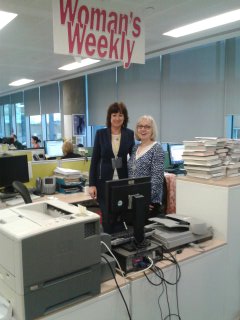
Of course, a ‘no’ can happen at any stage of this process.  If it’s a ‘no’, you will have an email from Maureen Street.  Now it has been rumoured that Maureen Street doesn’t exist. That she is just the pseudonym or ‘fall guy’ if you like – the made-up person who sends the rejections.  I can confirm she does exist and she is a very very nice lady. Here she is with Gaynor.

Gaynor Davies (left) Maureen Street (right)

And here are the two desks where so many decisions regarding the fate of our stories are made 🙂

So now you know!


Gaynor's desk (closest) Maureen's desk (by window)


Workshops and Writing Courses Happening Now

We are suddenly awash with writing courses – must be spring 🙂  In date order, soonest first, below are some of the ones I am personally involved with:
From 17th February, 2014 – 2nd March – Purbeck Literary Festival

There are all sorts of exciting events going on across the Purbecks. I am teaching How to Write and Sell Short Stories on 18th February, at the Limes Hotel in Swanage. 10 a.m. till 4.00 p.m. Cost £18.50 including lunch. Click here for details.

21 February 2014 – Woman’s Weekly, London (also running 11 April, 15th August and 1st September)

Woman’s Weekly Fiction Workshop (short stories with Della Galton and Gaynor Davies): 21 February at IPC Media, The Blue Fin Building, London SE1. 10 a.m till 4.30 p.m. Cost £65. Click here for details.

28 February to 2 March (weekend course) – Fishguard, Pembrokeshire

Write a Short Story Step by Step with Della Galton. Also other courses at Fishguard this weekend. Cost £229. Click here for details.

Saturday 22 March – Bournemouth

How to Write and Sell Short Stories. 10 a.m. till 4.00 p.m. Cost £45.00 Click here for details.

Sunday 23 March – Southend on Sea, Essex

This one’s not writing – but who doesn’t want to be happy? And I can personally vouch for the course because I’ve been on it.

How to Do Everything and be Happy. 10 a.m. till 4.00 p.m. Workshop leader, Peter Jones. Cost £45. Click here for details, and to book online.

Saturday 14th June – Bournemouth

How to Write and Sell Your Memoir. 10 a.m. till 4.00 p.m. Cost £45. Click here for details.

I also teach weekly classes in Bournemouth if you would like a weekly injection of inspiration. Please see this website for details or email me.

Happy writing all.

Tips on Entering Writing Competitions – Wednesday Writing Spot

I recently judged the H E Bates Short Story Competition, organised by the Northampton Writers Group. Morgen Bailey is the chair and for today’s Wednesday Writing Spot I’m delighted to welcome Morgen to my blog to give us her tips on entering writing competitions. Over to you, Morgen 🙂

Tips on entering Writing Competitions

Competitions are a great inspiration and not only get me writing something new (certainly for the themed ones) but even if I don’t get anywhere, I still have the story to do something else with, like submitting to women’s magazines here in the UK (although it’s more advisable to write specifically for their markets) or self-publishing to add to my collection of eBooks.

I’d love to give you advice that will guarantee a competition win but it won’t. Sorry about that. There are two reasons for this:

    1. You will never know how the judge will feel when he / she reads your story. He / she could be going through an acrimonious divorce and your divorce story is a painful reminder. I know, judges shouldn’t be personally involved in your writing but that’s the thing with fiction (and non-fiction of course); readers get emotionally involved – you should want them to, and if they do, it means your story ‘works’.
    2.  You will never know whom you’re up against. Yours could be a fantastic story – the best of twenty about unrequited love – but that’s it, it’s one of many on the same theme. It would have more chance of the judge seeing it if it’s the best but it’s the story about a pink tutu-wearing green alien they remember. I’m not saying to write something so way out that you run the risk of… erm, alienating the non-science-fiction-loving judge, but your story needs to ‘pop’. If you’re going to pick a well-worn theme – it is said, after all, that there are only seven plots – you need to find a new angle.

The most important thing? Read the guidelines. I can’t stress that enough. If they want a maximum of 2,000 words, don’t send them 3,000 or even 2,010 (or a 45-line poem when they only want 40). I’ve just finished judging the first ever NLG Flash Fiction Competition and had to disqualify one story because it was 610 words (max 500). We have Word, so we have a word counter – it’s easy to check and catch you out. Your story may be the best thing since sliced granary but no one will know because they won’t get to read it. I didn’t read the 610-word story, although I might go back out of curiosity.

Another usual pre-requisite is to not send a story (or poem) that has been published (online counts as published) or won / shortlisted in another competition. Another NLG story was disqualified because the author notified us saying he / she had submitted the story in error because it had gained second place in another competition. Ironically, it was also my second-place, so my third became second and another story became my third, and eleventh now highly commended. I don’t know who submitted the story (because I’m Head Judge – only our Secretary knows so it’s fair) but editors and judges remember those authors who do such things, so don’t. Keep a list. File your story in a particular folder. Be organised.

Another must is spell and grammar check. It sounds obvious but I spotted a ‘tine’ instead of ‘time’ in one piece and it lost a point because it was a careless error. Unless you’re writing a new story the day before the deadline, give yourself plenty of notice. Write the piece at least a week (the earlier the better) before you have to send it in, leave it for a day (preferably more) then edit it. Read your story out loud – it will sound different to how it sounds in your head and you will spot errors easier (especially if it’s been a while since you wrote / read it last).

Don’t leave it until the last minute. It’s very tempting to send in your story the day the competition ends just in case you want to make any last minute alterations, or so the judge might remember it coming in, but the organisers appreciate it if you’re early. It makes their job easier, as they can send the stories out to the judge/s in batches rather than in one go.

If the competition has a theme, stick to it. If they want a story set in the London Underground, don’t think you’re being clever by setting it in the Paris Metro or New York Subway, unless you’ve come from / are going to the London Underground. Last year’s H.E. Bates competition had (for the first time in its 20-year+ history) a theme; ‘A Walk at Midnight’, and we had a couple of stories which didn’t include a walk or set, at any point in the story, at midnight.

Choose a snappy title. Don’t be lazy and call it The Journey (a title of an old story of mine which I’ve since renamed No White Left). You can certainly use it as a working title but then a phrase might leap out at you when you’re writing it. I write a short story a day for my blog’s 5pm Fiction slot and it’s often what happens to me.

Research your judge. If he or she writes romance, the chances are s/he’d favour a love story over a slasher horror. If it’s the best thing they’ve ever read then you could still do well but again you’re running a risk. With most competitions, the Head Judge (the name advertised) will only see a selection of the stories, so even if you write to their taste, if the competition panel (often a writing group) don’t like it then it will never reach Mr / Mrs Famous Writer. ‘Named’ judges’ time costs money and most competitions can’t afford to pay a famous (or even semi-famous) author to sift through hundreds of entries.

So you want to make your story (or poem) as good as it can be to get through all those people and make the last one go “wow”. You never know it could even be me.

Morgen Bailey

morgen@morgenbailey.com

http://morgenbailey.wordpress.com

http://icanbuildyourwritingblog.wordpress.com


Thank you very much, Morgen, for being my guest today. Some very useful tips :


H E Bates Short Story Competition. Winners and Presentation

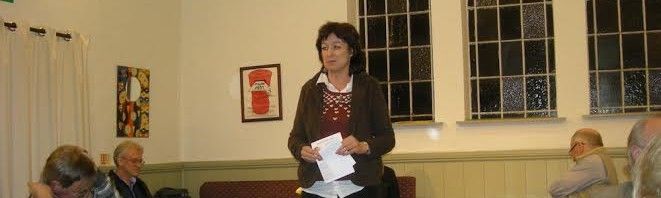
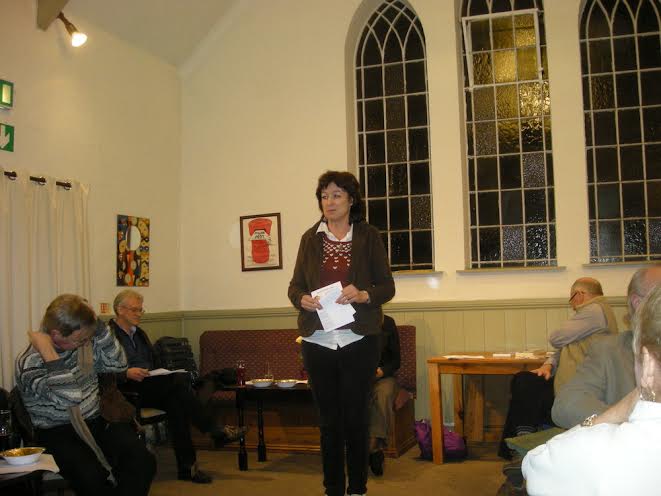
I was honoured to be asked to judge the 2013 H E Bates Short Story Competition, and last Friday 17th January I presented the prizes to the winners, which was both humbling (I wish I’d written some of those stories) and nerve racking (I had to do a short talk too). By the way, do these two gentlemen in the foreground and on the right of the photo look as though they are asleep? I’m sure I didn’t “hold forth” for that long!

So without further ado, here are the results and a brief summary of why I chose them.

Adult Section
1st prize: Last Tango in Space by Anne Corlett
2nd prize: Ancient Wing by Tracy Fells
3rd prize: Make Mine Mythical by Rosa Johnson

Under 18s
1st prize:Something In The Mist by Katie Bunting

Best short story written by a Northamptonshire writer:
Memories Through My Grandfather’s Eyes by Dave Martin

Why did I choose these stories? There were different reasons, but… they all had the X Factor. I’ve gone into a bit more detail below:

Memories Through my Grandfather’s Eyes was both warm and poignant and a lovely portrayal of an ordinary family.

Something In The Mist was both gripping and full of insight and I was impressed by the author’s grasp of storytelling and structure. It was in male viewpoint and I was even more impressed when I discovered the author was female.

Make Mine Mythical was very funny and had brilliant characterisation and dialogue.

Ancient Wing  was original, unusual, and beautifully written.  Tracy managed to make me love the ‘at first’ unsympathetic main character – well done.

Last Tango In Space was fabulous. I cried when I read it. I cried again when Anne read it out on Friday.  It was about an older couple on the first manned trip to Mars. Written in diary form, it was both amusing and deeply moving and ended with a fabulous universal truth. Thank you Anne for writing this. I wish I’d written it myself. I can give you no higher compliment.

Well done to all the winners of this incredibly hard to judge competition.

Thank you to everyone who entered.


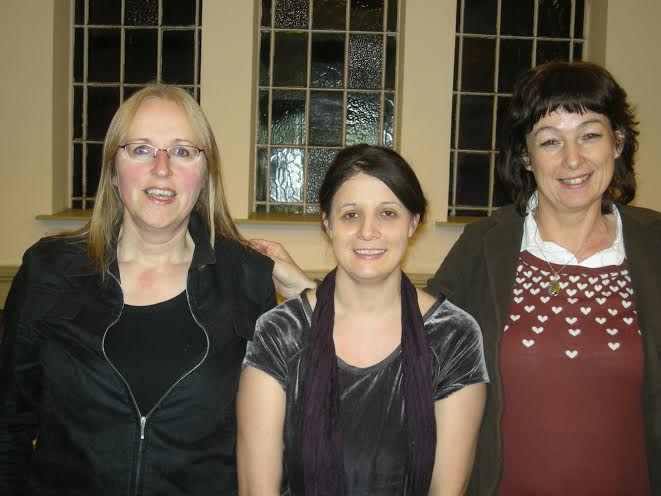
And here is Anne Corlett, winner of the H E Bates, with Morgen Bailey, Chair of the Northampton Writer’s Group, and myself.


Wednesday Writing Spot – What Would You Save in a Fire?

So… this is the year you are going to write that novel, sell a short story to a magazine, publish that memoir. In short, do everything you said you were going to do this time last year but didn’t quite get round to.  So what’s different?

You’re more determined/inspired/motivated? Delete as appropriate.

Maybe you don’t need to be any of those things. Maybe it’s simpler than that.

Can I tell you a story?

It is 1997, five a.m. on a winter’s morning. I am asleep in bed when I hear the sound of shouting.  I don’t stir much. I think I am dreaming, and even when it becomes apparent that I’m not, I assume that the shouting is aimed at my neighbour, Eric, who lives in the flat above mine. Eric is a commercial window cleaner. His boss picks him up at an ungodly hour to take him to work. Eric is also fairly deaf and in order to wake him, his boss has to bang hard on the door and shout, and sometimes throw stones up at the window.

Today, his boss is making one heck of a noise. Eric must be deeply asleep.

I hear the sound of smashing glass – and it strikes me that Eric’s boss must have thrown one too many stones at the upstairs window.  How irresponsible, I think, pulling the duvet up over my head.

“Fire, FIRE, your house is on fire!” shouts Eric’s boss, and finally I rouse myself. Now that is just too much.  Someone might think there really is a fire.  Now I am angry. I decide to go to my own front door and give him a piece of my mind.

The man standing on my step is not Eric’s boss, but a stranger. A passing taxi driver, I later discover.  “Your house is on fire,” he says urgently. “You have to get out.”

And suddenly I realise there are flames leaping out of the windows of Eric’s lounge – which is directly above the bedroom where I slept until a few moments before.

There is no time to fetch so much as my slippers. I and my dogs are out of that flat in seconds. And thankfully Eric isn’t in his either.  The fire brigade arrive, the heroic taxi driver melts away into the night. I stand across the road in my nightie and a kindly neighbour’s coat and watch my house burn.  One of the more surreal experiences of my life.

Now, I am not telling you all this for dramatic effect, but because of what happened next.

After the fire brigade had made sure the fire was out, a hunky fireman strolled across the road and said to me. “Very soon there will be water flooding through your ceilings. We don’t have much time but is there anything in there you would like to save?”

What would you save in a fire?  I didn’t know until that moment. But aside from animals and people, there was only one thing I really cared about in my flat.

My writing!

At the time, I’d been writing for about ten years and I worked off my dressing table. And it was in the days when it wasn’t so easy to back up your work.  (I made copies to floppy discs when I remembered) Ten years of my work was about to be drowned.

So…rather swiftly, the very nice fireman and I carried my tower, monitor and printer – all still attached because there wasn’t time to unscrew any cables out of my ‘shortly to be waterlogged’ flat to the safety of my car. It wasn’t my ancient PC I cared about, but the stories that were on it.

I’ve thought about that incident many times since.

I think I was lucky to be in that fire. It forced me to focus on what my priorities were. Aside from people and animals, writing was the most important thing in my life.

So what are your priorities? If you were in a fire what would you save? If you had six months to live, would you use it to write that novel?

Would you?

Sometimes I am asked if there’s a secret to my writing success. I think that this may be it 🙂

If you would like to know more about writing short stories or novels, do please check out my two latest writing guides: The Novel Writer’s Toolshed which is available for Kindle £1.88 and in paperback £4.99.

The Short Story Writer’s Toolshed which is available for Kindle £1.88 and in paperback £4.99.

Wednesday Writing Spot – New Year Resolutions for Writers – all under 1000 words

writing Inspiration

One writing resolution a month. All of them under 1000 words. How hard can it be 🙂

January

In 400 words – Begin with the words, ‘A dream I would like to achieve this year is…’ 

February

In 100 words  – Write the Valentine message you wish you’d had the nerve to send.

March

In 250 words – Describe a winter sea.  Be poetic. Use metaphor and simile.

April

In 700 words -­ Write a story about clocks.

May

In 50 words – What does summer mean to you?

June
In 950 words – Write a crime story with a twist

July
In 400 words – Write a monologue from the point of view of a character you’ve just created. Have them rant about something they care passionately about.

August
In 400 words – Have the character you created previously argue with someone who has an opposing point of view.

September
In 150 words – Write a letter to Writers’ Forum or Writing Magazine. Aim for star letter.

October
In 250 words – Write a blurb for the novel you might one day write.

November
In 250 words – Write the first page of this novel.  Find a title.

December

In 100 words or less – Give us the premise of this novel OR of your next story.

Happy Christmas

A very quick blog to say festive greetings and also, I must apologize for the distinct lack of reading material I’ve produced lately. In the last few weeks I’ve been moving out of my house, trying to find a new one, and sorting out Christmas, all whilst working as usual. Slightly tricky, even for a workaholic like me. So I just wanted to say, have a fabulous Christmas everyone. Full service shall be resumed in the New Year and thank you for following my blog 🙂

Tell your friends!

© Della Galton All rights reserved.
Powered by Cloudbase Media