Welcome to Della Galton’s website

How do I become a full time writer? I want to give up my day job.

This is a question I get asked a lot.  Both through my column for Writers’ Forum and also by strangers (and friends) who know what I do. Mostly the people who ask me want to write fiction.  (it’s much easier, incidentally to do it if you write non fiction.)

I asked this question of an author 30 years ago and their first reaction was to say, ‘Don’t do it.’  I ignored this slightly tongue in cheek advice and went ahead! Incidentally, it didn’t take long before I had to get another day job in order to pay my mortgage.

The next time I attempted it in 2000 I was more prepared. Preparation is essential, and will make the difference between success and failure. Everyone’s circumstances are different, of course, but here are my top tips for making the switch

  • You will need to be already established as a paid writer of fiction (or non fiction if that’s your chosen path). Doing both is a good plan I have found. Getting established takes time so it’s important to build up relationships with editors and publishers before you quit your day job.  I had been getting paid for my writing for 13 years before I gave up my day job the second time.
  • If possible, don’t give up your day job until your earnings as a writer equal your salary, or come close. Be prepared to live on half your income for a while. If this is impossible, don’t attempt it.
  • In the beginning you will need an alternative form of income as well. Then you will have at least some guaranteed income a month (important for bills, mortgage etc). This could be a part time job. It could be savings. It could be a pension. (I had savings and a part time job.)
  • Work out exactly what you will need to earn each month. Then work out exactly what you will need to sell each month in order to achieve it. Then write approximately double the amount of pieces that you will need to sell to allow for misses.You are bound to have some.
  • Pick a date and hand in your notice. You can always go back if things don’t work out.

This may all sound a little like a tale of caution. So I will add one more thing. Even though I work longer hours than I did while employed, even though it’s very hard at times and I never feel economically secure, writing for a living is still my dream job. I absolutely LOVE it.

Good luck with your journey.

PS if you want to know if your short stories are publishable, (or even if you just want to make them better) why not come along to my course on Sun 26 August and get some feedback on your story.

Venue: Kinson Community Centre, Bournemouth

Time: 10 till 4.00

Cost £40.00

(email me if you’d like further details)


How to Judge a Short Story Competition

Firstly, apologies from me! I haven’t written a blog for too long. I’ve been writing a novel and it was all consuming. It’s now winging its way to publishers via my agent, who loved it. So fingers crossed.

More on that soon. But here’s a question that came through to Dear Della recently, which might be of interest to you.

Q: I have been asked to judge a short story competition, having been a winner more than once in previous years.  I am thrilled to be asked, but also nervous.  Do you have a set criterion when you judge short story competitions yourself?

A: Yes I do.  The following is my own personal criterion for judging a short story competiton.

  1. Is it a short story and not just an extract or anecdote?
  2. Does it begin well – was I hooked?
  3. Are the characters believable and convincing?
  4. Do I care about the story or do I get to the end and think, ‘so what!’?
  5. Is the dialogue realistic and/or convincing?
  6. Does the plot work or is it contrived and/or predictable?
  7. Is the ending satisfying or does it tail off or feel contrived or predictable?
  8. Does the title add to the story?
  9. Is the pace right or does it feel rushed or drawn out?
  10. Does this story have the X Factor?

As you can see most of my points are measurable.  They will encompass factors like quality of writing, language and grammar. Number 10 is the one I use when I am trying to decide on a winner.  If a story has the X Factor it can sometimes be forgiven other minor faults. It’s difficult to pin down whether a story has the X Factor. They are the ones that send a shiver down my spine – or prompt me to say, ‘Wow.’  I wish I’d written that.  They might be clever or funny or poignant. And yes it’s a personal thing – one judge’s X factor may be another judge’s ‘not in a million years.’ But that is what makes a judge unique.

Have you ever judged a competition? I’d love to know your top tips.

Also on the subject of short stories – my next course is on Saturday 23 June, 2018 in Bournemouth.

Write a Short Story in a Day.

Venue: Kinson Community Centre.

Cost: £45

Please email me for further details.

Last but not least, you can unsubscribe from this email at any time by pressing the unsubscribe button or emailing me and I will unsubscribe you.  Many thanks for reading.

All best wishes

Della


How Much Do Writers Earn? The fact and the fiction

Another question from my Writers’ Forum postbag. The thorny old subject of money again. £60,000.00? I wish! I don’t think I even know any writers who earn that much but I stand to be corrected 🙂

Q I went on a website called “Indeed”. It claims that the average annual salary for an adult fiction writer is £60,000.

From what I read writers earn very little and don’t have the privilege of an annual salary, so I am a bit confused.

Is it because the salary varies geographically?

I also read something that certain type of authors (both fiction and non-fiction) can be employed? Is this true?

A There are all types of writing jobs. Editors, staff writers, copy editors journalists, script writers and novelists all come under the category of writers. Some are employed by magazines, newspapers or publishing houses and they receive an annual salary. Some are self-employed.  This is probably where the confusion arises.  However, I don’t know of ANY fiction writers who are employed and paid a salary.

An article published in The Guardian in July 2014 estimated the average writer’s earnings to be £11,000. This figure is lifted by the fact that a tiny percentage of writers earn a great deal. Think J K Rowling and E L James.

Another interesting statistic is that ten per cent of authors make fifty per cent of sales. It’s a sad and rather shocking fact that the lowest paid salaried employee in a publishing house will earn more than most writers.

A few years ago I was working at the London Book Fair, which was packed to capacity with industry specialists. There were very few writers – the people who make books actually possible. It struck me and my colleague that writers are at the bottom of the food chain.

And here’s another fact that underlines this perfectly. To celebrate the record sales of ‘Fifty Shades of Grey’, Random House US awarded every employee a bonus of $5000 dollars. Their authors did not receive this bonus.

According to a survey commissioned by the Authors’ Licensing & Collecting Society (ALCS) the numbers of authors making a living from writing are as follow. In 2005, 40% of authors earned their income solely from writing. By 2013, this had dropped to just 11.5%.

Making a living solely from writing fiction is very tough. Few writers succeed. The market is fiercely competitive. The reality is this:

Most ‘full time’ self-employed writers, particularly fiction writers, subsidise their income by some other writing-related activity. These include talks, teaching, workshops, critiques, columns. Some have a separate income from non-writing related activities.

Most professional writers work very long hours and they dream that their next novel will be the BIG ONE.  Which, of course, it might! There is always the possibility that you might be able to break into being one of the top ten per cent. Hold on to the dream. But keep expectations realistic.

By the way, my novel, The Morning After The Life Before is 99p this week (till 22 October). Now maybe if I could sell 60,000 copies of that… 🙂 


How do I stop my romances becoming predictable?

A rose by any other name!

Here’s another question from a recent postbag at Writers’ Forum. This one comes up quite a bit.  We’re talking fictional ones by the way!

Q A common cause for the rejection of short stories (I know, because I’ve received many!) is that “the story line was too predictable”. I find this very hard to avoid particularly when writing a romantic story for the women’s magazine market, when the maximum number of recommended characters is only three or four. What can be done to stop the reader from working out that the boy and girl who meet at the beginning of the story are not inevitably going to end up in each other’s arms?

A First of all, I emphasize with you. I agree that writing a romantic short story for a magazine is one of the hardest genres to crack, for exactly the reasons you state.  Here are some tips that I hope may help:

  • While the romance is likely to be a little bit predictable, other aspects of the story needn’t be.  You might want to try a unique setting. I’ve sold more than one story which featured a wedding or romance set somewhere unusual, for example an ice hotel. Think about setting your romances somewhere unique or unlikely.
  • You can also experiment with viewpoint. It’s a common misconception to think that romances need to be told solely from the female perspective. They don’t. A romance told from the male perspective, or possibly even a child’s perspective (providing it isn’t the child having the romance) can work just as well and make your story a little different. You might also want to consider dual viewpoint, a romance told from both the hero and the heroine’s viewpoint. I’ve sold a few of these.
  • The romance needn’t be your main plot line either.  It could actually be a subplot. Perhaps consider writing a family story, where the romance is relevant to more than one generation or a cosy crime story where the romance underlays the solving of a crime.
  • Also, don’t forget that it’s possible for the writing itself to be predictable. The use of language and a slightly different style can give romance a new freshness. As can a slightly different structure, i.e. a monologue or diary format.

There’s actually a very fine line between predictable and unpredictable. And actually it’s always an editor’s perception, there’s a little bit of luck involved too.

So I wish you good luck.

Do all stories need conflict? and How do unknown writers get published?

A couple more question from my post bag at Writers’ Forum 🙂

Q: Do all stories have to feature conflict, resolution and growth, with false hopes and disappointments along the way? I appreciate that a straightforward happy little narrative would be largely purposeless and therefore unengaging, but I find it hard to accept that all stories should follow the ‘story arc’.

A You are absolutely right when you say that a straightforward, happy narrative might be unexciting to read. I call stories like this linear, i.e. a piece of writing that moves in a straight line with no surprises to a conclusion that is largely predictable. I think that there should be a story arc, but that can mean many different things.  My personal definition of a story is a piece of writing where a character begins with a problem or conflict, which is resolved by the end in a satisfying, but unexpected way. The character should change in some way by the end. This provides the main arc of the story. I don’t think this can be too formulaic.

It’s not a case of putting in complications or ups and downs for the sake of it (as I thought when I first started writing stories).  They all have to be relevant, both to the initial problem, and also to the character. There is huge scope in this. You can use different structures, you can use flashback, and you should use emotion, which for me, means writing from the heart. You can create twists by the use of misdirection. You can create surprises by withholding information from the reader.

Much depends on the length of the story. It’s difficult to have a big story arc in a flash fiction piece of say 500 words or even 1000. But there should still be some kind of story arc or progression. I hope this helps to clarify.

***

Q This magazine seems to be full of advice for writers who have already ‘made it’ and had their work published. However, there are still many of us who are trying to ‘make it’ and from our side of the fence getting published can sometimes feel like an impossible feat. From here, it seems that to sell your work and be published, you already need to have been published previously. But what if, like me, you don’t have any previous examples or clippings to show? How do you then sell your work and get published?

A Let me reassure you that you don’t have to have been published to get published. We all have to start somewhere. The key to getting published is to write what publishers and editors want. So first you need to know what that is. And you can find out by doing your own market research. Here are my top tips on market research.

  1. If you want to write for a particular magazine then first of all make sure they accept freelance submissions. If they don’t you’ll be wasting your time approaching them. Whether it’s fiction or features you want to write, ask for their contributor’s guidelines.
  2. Buy several copies of the magazine and look at house style. Is it chatty, or more serious and/or literary?
  3. Check the lengths of fiction/features they publish, 1000 words, 2000 words etc. (writing outside of these lengths will result in automatic rejection because they won’t have the slots to put your work.)
  4. Check the target reader they are aiming for, including age, sex, type of person. Adverts and letter pages are a good guide to this.
  5. Check their house style – do they prefer first person viewpoint or third, male or female etc.
  6. Make sure you are writing for their target reader.
  7. Make sure you send your submission to the right person and in the right format, e.g. via email or by snail mail.

If you are writing features you should send a query letter/email first. Head up your query with an eye catching title or question. I highly recommend Solange Hando’s book, Be a Travel Writer, Live your Dreams, Sell your Features: Travel Writing Step by Step. This is a book about selling travel features, but its excellent advice applies to selling all features.

Here’s an example of a query letter sent to a dog lovers magazine, which resulted in me being commissioned to write the feature.

Dear Debbie,

Feature query – Ten ways to help your local dog sanctuary

I was wondering if you’d be interested in a feature about the above. As you know, many sanctuaries, especially those that rescue dogs are in dire straits, thanks to the credit crunch. And the small ones tend to get hit the hardest.

Since June this year, myself and four friends have raised nearly £1000 for DAWG (Dorset Animal Workers Group).

The feature would cover various simple ways of raising money, i.e. what we did – and how we did it. Plus other things dog lovers can do to help their local rescue centre. I can provide illustrating pictures.

I’ll look forward to hearing what you think.

It is possible for a writer with no credits to be commissioned to write a feature. You just have to write what is wanted. Once you have been commissioned, make sure you supply the feature promptly. Be professional. You will usually have to try more than once. Perseverance in all types of writing for publication is the key.  I hope this helps. Good luck.

Submitting stories to magazines – should I send a cover letter?

Here is another question from my Dear Della page that I get asked regularly.

Q Whenever I submit a short story to a magazine, I give basic details and contact information on the cover sheet. Is it always necessary to include an introductory letter with brief synopsis as well? Apart from it being time consuming for a reader or editor, I worry more about the letter than the story!

A I’ve had several writers in touch about this dilemma and the short answer is no, it’s not always necessary to include an introductory letter. The cover sheet is enough for most fiction editors. It is not usually necessary to include a synopsis either and some magazines actually advise against doing this. However, do check the guidelines. If they ask you to submit a covering letter, then do so. It can be very simple. Here is one I have used.

Dear Fiction Editor (insert name – if you don’t know it, find out)

Please find enclosed my short story, THE RED SHOE (1000 words) that I hope might be suitable for publication in… (insert name of magazine).

I enclose a stamped addressed envelope for your reply, and look forward to hearing what you think.

Many thanks for your time.

Yours sincerely

Also please do make sure your SAE has sufficient postage to return the story to you. Or you will never know its fate.

***

I teach weekly writing classes at Kinson Community Centre, Pelhams Park, Kinson, Bournemouth. Thursday evenings, Friday mornings. Term dates in side panel to right of this page.

My next Saturday course on How to Write and Sell Short Stories is in Kinson on Saturday 25 April 2015.  £45.00 for the day. Please do check the course page of this website for further details and email me via website to book. I’m also doing a weekend course (Write a Short Story in a weekend) at the Royal Agricultural University, Cirencester) 10th to 12th April. £240. I am also doing the Twist Ending at Woman’s Weekly on 13th April £75.00. See side panel to the right for more details. The latter two courses must be booked via Relax and Write and Woman’s Weekly websites respectively.

Happy writing

Three Questions I Get Asked About Short Stories

Q How do I make my stories less predictable? Particularly if I’m using a common theme, for example, romance? What can be done to stop the reader from working out that the boy and girl who meet at the beginning of the story are not inevitably going to end up in each other’s arms?

A I agree that writing a romantic short story for a magazine is one of the hardest genres to crack, for exactly the reasons you state.  Here are some tips that I hope may help.

While the romance is likely to be a little bit predictable, other aspects of the story needn’t be.  You might want to try a unique setting. I’ve sold more than one story which featured a romance set somewhere unusual, for example, an ice hotel.

You can also experiment with viewpoint. It’s a common misconception to think that romances need to be told solely from the female perspective. They don’t. A romance told from the male perspective, or possibly even a child’s perspective (providing it isn’t the child having the romance) can work just as well and make your story a little different. You might also want to consider dual viewpoint, a romance told from both the hero and the heroine’s viewpoint. I’ve sold a few of these too.

The romance needn’t be your main plot line either.  It could actually be a subplot. Perhaps consider writing a family story, where the romance is relevant to more than one generation or a cozy crime story where the romance underlays the solving of a crime.

Also, don’t forget that it’s possible for the writing itself to be predictable. The use of language and a slightly different style can give romance a new freshness. As can a slightly different structure, i.e. a monologue or diary format.

Q My short stories seem a little dull. What can I do about this?

A If it’s the characters, make them a little quirky. Try giving them conflicting traits, for example, a traffic warden, who ices cakes as a hobby. Or a single parent who is a famous session musician.

If it’s the story that’s dull, try a universal truth. What is your story actually about? In my experience the best stories are ones that highlight some aspect of the human condition. Perhaps an unusual one, for example, children can often teach us more than we can teach them. Or, not all sweet little old ladies are sweet.

Q What is a short story?

A Never forget that a short story is not just a sequence of events. It should have a beginning, a middle and an end.  It will probably feature one central character with a problem that must be resolved (by the central character) in a way that is neither predictable nor contrived.  Not easy! The main character should also have undergone some kind of change. Maybe they have become a better person – or a worse one?

NB My weekly classes are held on Thursday Evenings, 7-9 and Friday Mornings, 10-12 at Kinson Community Centre, Millhams Road, Kinson. Email me if you’d like more details, or leave a message on this post.

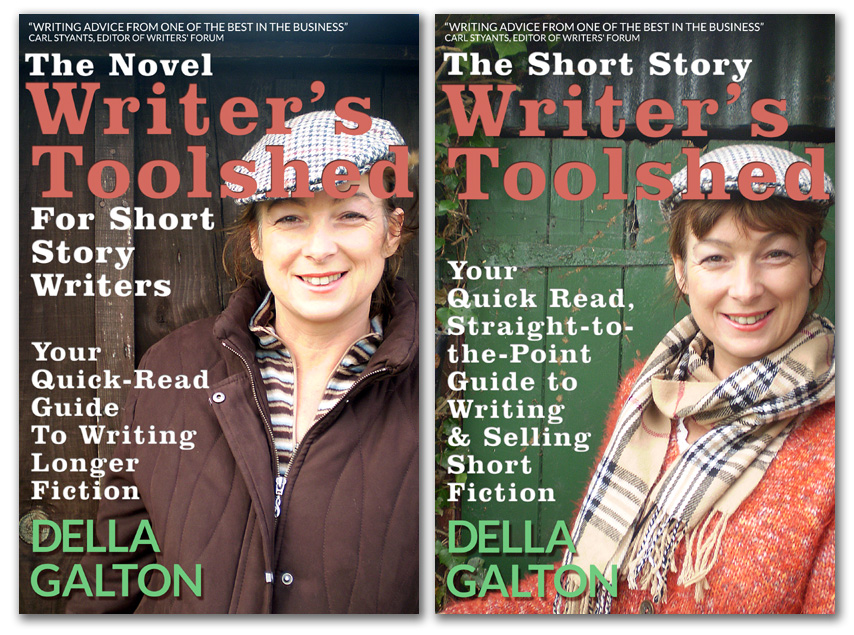
If you would like to know more about writing, two of my writing books, The Short Story Writer’s Toolshed and The Novel Writer’s Toolshed are currently 99p on Amazon if you have a kindle or a kindle app.

Tips for Writers – Novel Layout

I had a letter recently via my Dear Della page in Writers’ Forum from  a lady who was anxious about the layout of a novel when submitting to publishers. I know there’s a wealth of information out there about writing, but sometimes the basic stuff is overlooked. And the hardest questions to ask are the ones we feel we ought to know already.

So here are some basic presentation guidelines for writers who are interested in how to present a novel to publishers.

How you lay out your manuscript can vary from publisher to publisher, for example, Mills & Boon have very specific requirements (these are laid out in detail in their guidelines).  So do check if this applies to individual publishers. However, as a general rule, use the following guidelines:

  • Use double line spacing and an easy to read font. Times New Roman size 12/14 is an industry standard.
  • Left and right hand margins should be approximately 1inch.
  • There should be a title page which should include your name and address, (phone number and e mail address optional) the title of the story and the approximate number of words.
  • The title and page number should also appear on every page of the manuscript. It’s usual to put them in the header and footer. This will also prevent your pages going awry if you later alter your document.
  • Each chapter should begin on a new page.
  • Dialogue is indented, as are new paragraphs. There should not be a double space between paragraphs.
  • A double space to indicate scene breaks is only necessary if it’s not clear there’s a scene break without one, for example if there is a time gap or a change of viewpoint.
  • Text following a gap (including dialogue) is not indented.
If you’re interested in writing short stories – or novels – please check out The Toolsheds. Both are in paperback and are available for kindle.

Agny Ant Letter

I received this letter today for my Dear Della page.

Deer Dela,

I have wrote a book and going too sellfpublish it but my friedn Kimberley says what are them colored skwiggly lines under al the wrods and i dont now but do you now if the swiggles will com out in the book wehn i done it pleaase.

sellfpublsihed arthor of IT WERE MY LIFE?

OK, so I know it was a spoof, but it did make me smile, and as I can’t use it for my actual Dear Della column in Writers’ Forum, I thought I would print it here. It came from an author and reviewer friend of mine who has read so many badly produced self published books lately, she feels like throwing her hands up in despair.

Not of course that any of us would do that, would we?  Excuse me, I just have to rush off and check my latest proof copy for my publisher 🙂


Tell your friends!

© Della Galton All rights reserved.
Powered by Cloudbase Media