This year, as I mentioned in my last blog, I’m attempting to write 50,000 words of short stories during the month of November for Nanowrimo. We are 7 days in. I thought you might like to know how I’m getting on.
Statistics
I’ve written 14,000 words so far in 7 days.
I’ve started ten stories.
I’ve finished eight of them in first draft.
So far I’ve edited two and sent two out.
Yay, so it feels like I am achieving something.
Inspiration
My week started with a bang. Last weekend I was on a roll. The words flowed. I wrote one longish story (2700 words), quite emotional, good structure that I liked a lot. Then another two pager (2000 words) which was lighthearted and fun. Quite liked this one too.
The next story I started, which was supposed to be a very short one pager decided it might quite like to be a serial. That’s one of the ones I haven’t finished, it’s about 2000 words currently.
Then came the one pagers, two of which are finished, edited and sent. The rest all need editing and I’m not sure I’m happy with the endings. I rarely am happy with my endings straight off.
It’s harder some days than others. It’s pretty full on writing like this. And I find it quite tiring.
Enjoyment Factor
Mostly, however, I am having a wonderful time. I think I mentioned that before. It’s incredibly freeing. I’m not obsessing over any of the stories or worrying about them. I can’t even remember exactly what I’ve written.
Grass roots
It takes me back to when I began writing short stories. I used to write at speed then. When I started to write full time, I wrote three stories a week. Every week. One on Monday morning, one on Monday afternoon, one on Tuesday morning. The remainder of the week was spent editing these three, teaching my five writing classes and editing any rewrites/rejections that came back in. I don’t do that any more. There seems to be far more PR and publicity work to do. Oh and I don’t think there was much social media then either.
The Down Side
Is there one? Yes, possibly.
A part of me really really wants to edit as I go. It’s hard to resist that. It’s difficult to discipline myself not to look at yesterday’s story.
It also means I had to cancel virtually everything else I do in November. Apart from prebooked essentials, for example, tomorrow I’m teaching at Woman’s Weekly all day. I will leave my house at 5.45 a.m. and get back about 10.00 pm. I won’t be writing any Nano tomorrow. Mind you, if I was going on the train I would have done!
I’ve had to virtually give up social media. (is that a down side!) Oh, and answering emails.
My friends think I’m dead!
Oh, and I’m also moving house, which is slightly stressing me out. Haven’t packed much!
Week Two
This may be harder as I have 3 other commitments this week. I will report back. How is everyone else getting on? Don’t forget, if you need any help with short stories, The Short Story Writer’s Toolshed is quite good. Even if I do say so myself! 🙂
As I mentioned in my last blog I’m busy doing Nanowrimo this month. But as usual I’m writing 50k of short stories in November not a novel. This is more useful for me, being as shorts are my day job. I thought I’d share some of how I work with you – in case it’s helpful. Here are my top tips.
Keep them all in one document. I call mine Short Story Bonanza 2015 (Nano likes a title). And it’s easier to keep a word count if they are all in one place. I do start a new page for each story and I head it up with the date. (I don’t often have a title when I start a story.)
I don’t necessarily start a new story each day. I try to finish the one from the day before. After all, the object of doing Nano is that I write saleable stories and they have to be finished at some point. So I finish as many as I can in draft. But there might still be the odd one unfinished. And that doesn’t matter. Very freeing.
Make Nano the first thing you do. I tend to get up early at least every other day and start at 6 ish. That way my words are often done by nine and I can get on with the rest of my day. I can’t tell you how good that feels!
Use prompts to get going. I love A Writer’s Book Of Days by Judy Reeves. It has a prompt for every day of the year. Fabulous. I’m not a plotter. I never have been. I sit at my desk, and I start typing. I trust the process. The main thing which stops us writing is us. Our lack of confidence. Our internal editors. Switch off these negatives and just write. You can do it.
Do not use any Nanowrimo time for editing. Always do your daily word count first. Edit later. I edit most of my Nano stories in December. I like editing and it’s a lovely thing to do in December. I do edit some of the Nano shorts in November. But I take them out of the main document and save them as a new document. I’m always cutting when I’m editing so I don’t want to be cutting any of my nano words, do I?
Nano with a friend. I’ve got a writing friend coming over later today and we’re going to have a go at writing a story each, using the same theme. This makes it so much more fun. And it’s inspiring. And we can get feedback straight away should we want to edit the story and send it out before the end of Nano.
Oh and one last bonus tip.Make sure you’re stocked up on coffee or biscuits! Or whatever you need to reward yourself! (cake in my case). We deserve it.
And if you’d like any help with writing short stories, please do check out my book, The Short Story Writer’s Toolshed. £2.49 for kindle or £4.99 for the paperback.
It’s coming up to Nanowrimo again isn’t it? That’s National Novel Writing Month for the uninitiated. That’s when you sign up to write a 50,000 word novel in the month of November. Or 50,000 words worth of short stories in my case. It works out at about 1660 words a day. I love it. I love deadlines. Even if they are self imposed ones!
I’ve done it for the last two years. I thought you might be interested in some stats. I do love stats! This is what I did last year.
25 stories written.
17 of those sold to date.
5 still circulating.
3 still need work so not out there yet.
Income from stories to date £2985.00
Not bad for a months work. It wasn’t of course really a month’s work because I edited a lot of them in December although I did edit about five in November as well as write them.
But what I really love about Nano is the freedom to just start a new story each day without worrying about the previous day’s. Because I’m writing so many I don’t worry if one doesn’t work out – who cares? I just start again the following day. It’s very liberating.
Am I going to do it again this November? You bet I am. The way I see it you can’t lose. Even if you don’t complete the target – I fell short in 2013 by about 14k – you still end up writing more than you would have done anyway. So who’s in? Will you be doing Nano this year?
And while we’re on the subject of short stories can I just mention that one of my books on writing short stories, The Short Story Writer’s Toolshed, is only 99p for kindle from now (assuming you’re reading this on Sunday 25 October 2015) until 31st October 2015. Just in case you need any inspiration. 🙂
If you’ve read this blog lately, you’ll know I’ve been doing the NaNoWriMo challenge, i.e. I signed up to write a 50,000 word novel during the month of November. Well, actually, I’m a nano rebel. I decided it would be more fun to write 50,000 words of short stories instead of writing a novel. So that’s what I’ve actually been doing. Here’s how it’s going so far.
I’m behind. It’s day 22, so I should have written 36,666 words. I have actually written 30,625 words. But hey, the good news is that I’ve written a whole pile of short stories. I’ve just had a bit of a tally. So far I’ve completed:
8 stories of approx 1000 words
2 of 3000 words
2 of 2500 words
(The rest of the words are beginnings and ideas that aren’t fully developed – might be interesting to come back to later)
Of the completed 8 short stories, 3 are edited, polished and submitted to mags. 1 is sold. It’s called the Lebkuchen Heart and Take a Break bought it for their New Year issue of Fiction Feast. Yippee. The other short ones are complete (ish) but need editing and polishing.
Both the 3000 word stories are also complete, but need editing and polishing.
1 of the 2500 word stories is polished, edited and submitted. The other I just finished writing today, so still needs an edit and polish.
But that still means I have 12 stories done so far up to at least draft stage.
Plus a pile of beginnings that I may go back to and develop.
Plus a pile of words that may have the nugget of a character or idea in them but that aren’t very structured.
So being behind on my word count isn’t a problem. I am thrilled. I never really expected to do this much. Especially as I’m in the throes of moving house so lots of packing and sorting out is going on.
It’s really inspiring and magical writing short stories every day without having to worry too much if they are a) any good and b) finished. Some of them I haven’t bothered finishing because they’re not working. Usually I’d struggle with that and waste loads of time flogging a dead horse – excuse the cliché. I’ve used all my original phrases in Nano stories 🙂
My top tip for doing Nano – or at least the thing that’s worked best for me, is to do it first thing. I don’t do anything else, not even check emails or go on Facebook or Twitter when I get to my computer. I just open up my Nanowrimo document, type the date, and start on today’s story. (I don’t – even if I really want to – edit yesterdays. Although I have let myself finish it if I didn’t manage to finish it the day before.)
It’s fantastic. Wonderfully Liberating.
Better get back to work. But I’d love to hear about other people’s Nanowrimo experiences. How are you getting on?
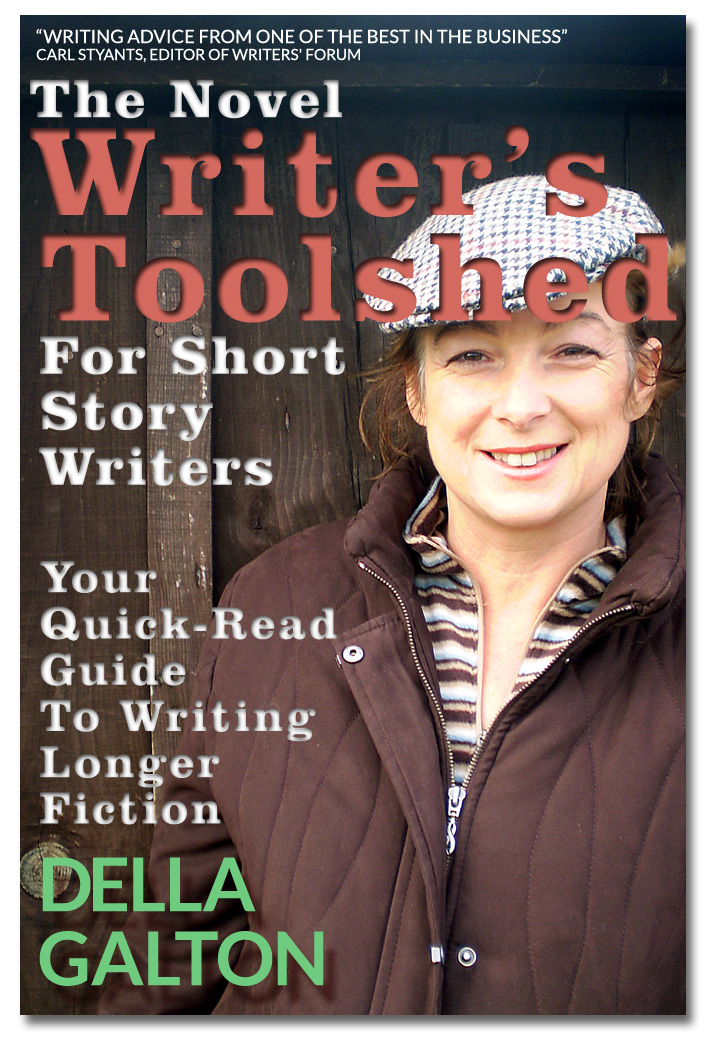
As I think I may have mentioned (once or twice) I now have two Writer’s Toolshed books in existence. Apparently there has been some confusion and a few people think there is still only one. So in the interests of setting the record straight, no, there really are two. And to prove it here they both are side by side. (in the same room!)
The Toolshed Collection
The Short Story Writer’s Toolshed is about writing short stories. And The Novel Writer’s Toolshed is – oddly enough – about writing novels – BUT The Novel Writer’s Toolshed is for writers who usually write short stories. It would actually be just as useful for novelists who fancy writing short stories instead because it’s specifically about the differences between the two forms. Phew! That was complicated. Hope it makes sense?
Tell you what – why don’t I reproduce the beginning of The Novel Writer’s Toolshed here – just in case anyone would like to check it out. Here it is:
Short Stories Versus Novels What’s the Difference?
Making the transition between writing short stories and writing your first novel isn’t as simple as you might think. Or at least it wasn’t for me. I’d had a fair amount of success with my short stories and I didn’t think that writing a novel would present too much of a problem. Surely it was just a short story with more words, more characters and more plot, wasn’t it?
No doubt, some of you are already sniggering at my naivety, and I was naïve. I made a lot of mistakes before I managed to write a publishable novel. Many of them were down to assumptions I had that simply weren’t true.
Yes, there are similarities between the short story and the novel and yes many of the techniques used for one can be transferred successfully to the other, but there are an awful lot of differences too.
The object of this book is to help you avoid some of the mistakes I made. Let’s take a quick look at some of the differences before we go into more detail about what’s in the toolshed, and hopefully this will make your transition a little smoother than mine was!
Length
This is probably the most obvious difference. Not many short stories are longer than about 5,000 words and even a short novel is at least ten times longer than that. The average length for a novel – if there is such a thing – is somewhere between about 50,000 and 120,000 words, depending on the type of novel and the publisher’s requirements.
Unlike a short story, which can be written and edited in a few days, a novel is going to take a substantial amount of time and work, which brings me on to my next point nicely.
Subject
What you write is always a fairly important question – time is our most precious commodity – but it’s not quite as important when you’re choosing what your next short story is about. After all, writing a short story takes significantly less time than writing a novel. We can afford to experiment a bit more. However, if you are going to spend a great deal of your precious time and energy on your novel – which you will if you’re going to do it properly – then it isn’t a bad idea to choose something you are passionate about. There are two main reasons for this:
1) If you are enjoying the writing, you are more likely to finish it.
2) If you don’t end up selling it then at least you will have enjoyed its creation and hence won’t feel your time would have been better spent doing cross stitch or playing golf!
I have no idea of the statistics on unfinished novels, but I bet there are thousands of them, languishing in desks or on computers across the country. They are started in a flash of inspiration and then the author finds they peter out at around 27,000 words, or perhaps worse, are finished in 27,000 words.
The percentage of first novels that are published is also very small. I have heard various figures quoted, but I won’t depress you with them. Besides, who really knows? A great many writers don’t even send their first novels out to publishers and a great many more are told by their publishers that although this is the eighth book they’ve actually written, it will be marketed as their debut novel.
This is not intended to put you off, far from it. Write your novel, keep an eye on the market, but primarily do it for the love of it.
My first novel, incidentally, which was written when I was about twenty, is somewhere in our loft, along with the other three novels I wrote before I managed to write one that was publishable!
Right then, let’s have a quick look at what’s on each of the shelves, whist keeping the differences between short story and novel in mind.
Planning, plotting, pace and timescale
A short story plot, by its nature, needs to be kept fairly simple. There isn’t enough room for it to be complicated. Generally a short story will tend to focus on a single event or theme.
If you are writing several thousand words you will need a much more developed plot, or perhaps one main plot and some interlinking subplots to sustain the length. Whereas a short story can follow a single idea, longer fiction tends to need more than one.
There isn’t room to hang around too much in a novel either, but you do need to have a very good control of pace. Contrary to what I thought when I started my novel writing journey, there is no room for waffle. Every word must still count. For many short story writers, pace is the hardest thing to adjust to when they begin to write longer fiction.
Setting
Setting in a novel is much more important than it is in a short story. In certain types of novels, for example regional sagas, it is equally as important as character. I will cover setting in detail under Shelf Two. All I want to say here is that you need to show setting through the eyes of your viewpoint characters – do not paste it into your novel in blocks or your reader will probably skip it!
Characters and viewpoint
A short story of a thousand words almost certainly won’t have more than two or three characters, one of whom will be the main character. There is a lot more room for characters in a novel although that doesn’t mean you should attempt to have a cast of hundreds! You will still need to know whose story it is – this is perhaps even more important in a novel than a short story as it’s much easier to lose focus – and all of your characters must be essential.
In a short story there is often only room for one viewpoint. In a novel there is room for more. Using the viewpoint of more than one character can add a great deal of depth to a novel if done with skill.
Dialogue
In a short story your reader will probably forgive you if your characters don’t have recognisable and individual voices. In a novel, they probably won’t. So character voice is one of the most important things to work on in longer fiction.
The first page and beyond
It’s vital to get your first page right. It is just as vital not to get stuck on it. I have a personal theory that it’s difficult to write the first page of your novel until you’ve written the rest of it. When I’m writing a short story I find the ending is the most difficult part. When I’m writing a novel I find it’s the opposite. It’s easy to write the last page, but very difficult to write the first.
Development, author voice and endings
Developing a story is fairly easy. The middle follows on naturally from the beginning – and so it is with novels, only it’s much easier to end up with a saggy middle in a novel – this can be solved by careful control of pace and also, I think by strong author voice. Thankfully, while ending a short story is tricky, bringing a novel to a satisfactory conclusion is much easier.
Structure and flashback
How will you structure your novel? Deciding before you begin to write can help you to plan it. Structure is a short story writer’s friend, but it’s a novelist’s best friend because there are far more options.
Your novel might have a prologue. It might be split into parts and it will probably have chapters. You’re not limited to flashback. You can use flash forward too! It is great fun to play with time in a novel.
Editing and revision
The main difference between editing and revision of the two forms is time. A short story can be edited in a morning or an afternoon. A novel is much more unwieldy. Using a plan can help.
The Title, the synopsis, the blurb
A good title is always important, but it’s more vital for a novel than a short story, as it’s one of your key selling points. A great title can sell a novel. A bad one can cause it to sink without trace.
Most novelists I have spoken to hate writing a synopsis. This is something you rarely have to do for short stories but which is an essential part of a novelist’s job. Or is it?
These days it’s probably more important to be able to write a blurb. Has the synopsis taken over from the blurb? What’s the difference? On Shelf Nine you’ll find some examples of both.
Finding an Agent – Do you need one?
The short answer is no. You have never needed an agent for short stories and you don’t necessarily need an agent for novels either, these days, but is it worth going alone? If you do want to look for an agent or a publisher, Shelf Ten, will show you how to proceed.
So there you have it – a little taster of what the Novel Writer’s Toolshed is about.
if you would like to know more, do please check out The Novel Writer’s Toolshed which is available for Kindle £1.88 and in paperback £4.99.
The Short Story Writer’s Toolshed is currently available for Kindle £1.88. Paperback coming very soon.
And if you just fancy a bit of light reading (pun intended), Ten Weeks to Target, my new novella is available as a Kindle book too for just £1.53 🙂
If you’ve ever tried to write a novel and you’re on social media – particularly around this time of year – you have probably heard of National Novel Writing Month (NaNoWriMo for short). It’s simple, you write a novel in a month. You start it on 1st November and you finish on the 30th November.
Of course you can do that any month of the year but the idea of signing up for NaNoWriMo is that you do it in November and you don’t do it alone. Thousands of other people around the globe do it alongside you. In 2012 341,375 people signed up for the challenge!
Once you have registered with NaNoWriMo, click here, i.e. made a commitment (very motivating – and quite scary) you upload your daily word count to the site. You can even scramble your words – look at their Frequently Asked Questions to find out how – that’s if you’re worried about someone plagiarizing your potential best seller 🙂
To qualify as having written a novel in 30 days you have to write a total of 50,000 words 1666 words a day. Simples!
Well, we all know it isn’t simple, but clearly it is doable and actually the ethos behind NanWriMo is that you just write and you don’t stop to edit and beat yourself up over whether it’s perfect. This is great if you’re a procrastinator like I am.
Some Frequently Asked Questions (Della style)
Why would I want to do it?
Well, for the challenge, for fun? (depending on your definition of fun). Or maybe just to see if you can. That’s why I’m going to do it. I’ve been writing less and less fiction lately and I want to get back into the swing of it. I want to focus on my fiction writing and this seems like a great way to do it.
Where do I find the time?
I’m not sure. Other writers I’ve spoken to say they give up television, or social media (yikes) or they get up an hour earlier or go to bed an hour later. How you do it is up to you. The point is that you do it – and it’s only for a month. So it’s not such a huge sacrifice.
What if I fail?
Do you know, I’ve already made up my mind that I can’t really fail. Because even if I don’t complete 50k I will sure as hell have a lot more words than I’d have had if I didn’t commit myself to writing 1600 words a day. There’s a very good chance I’m going to at least begin the challenge. So failing isn’t actually going to be a factor.
I usually write short stories – how do I write a novel?
This last question is in fact a shameless excuse to tell you about my new writing guide, The Novel Writer’s Toolshed (for short story writers).
This is the book I wish I’d had when I moved from writing short stories to writing novels. It’s available for kindle, just £1.88. Click here. A week from now it will be available in paperback. (Don’t panic – I’ll remind you)