Welcome to Della Galton’s website

What Do Your Short Story characters Look Like?

Characterisation is the means by which you make your fictional characters appear to be real people. It is probably the most important part of any piece of fiction. If the reader doesn’t care about your character, he or she won’t read on.

Your characters reveal their personalities in much the same way as real people
i.e. via what they look like, what they do and say and what they feel.

Appearance
It’s not usually necessary to describe your character at length in a short story (unless their appearance is critical to the plot). All of the following examples come from 1000 word stories. The briefest touches can bring a character to life.

Example one (A City Girl at Heart – People’s Friend)
‘So…how are you settling in?’ I asked Andy when he phoned me the weekend after he’d moved into the cottage.
‘Fine, thanks. Absolutely fine.’
I sensed a note of unease beneath his cheery words. ‘But..?’ I prompted.
‘I keep hitting my head on doorways.’

Example two (Brief Encounter – Woman’s Weekly)
Jonathon wasn’t her usual type. He wore his hair in a ponytail. He wasn’t over tall, but he had big hands and feet, there was a comforting solidity about him. She could imagine herself snuggled up and protected in his arms.
“I build racing cars for a living,” he’d told her as they’d gone through all the polite introductions stuff. “How about you?”
“I’m a nurse. I probably treat people who’ve injured themselves in your cars.”

As you can see, these are very brief physical descriptions, but they are enough to brush stroke a character’s appearance. We know Andy is tall. Jonathan has long hair and is big boned.

But now for a story where appearance is critical to the plot.

Example Three (Mirror Mirror – Take A Break)
“I look fat in it, don’t I?”
Kath could clearly hear the girl’s voice in the next cubicle along. She was talking to her friend, another teenager. Kath had seen them coming in to the changing rooms earlier, both tall and leggy and beautiful.
But not as confident as they looked, she thought now, as she glanced appraisingly in the mirror of her own cubicle. Now she’d taken her top off she could see the slight bulge over her waistband and the tops of her arms weren’t as trim as they’d been only a couple of years ago. She gave a wry little smile.
‘You don’t know what you’ve got till it’s gone.’ Never was there a truer saying than that.

(Extract taken from later in Mirror Mirror)
Kath slipped the dress over her head and smoothed its cashmere softness down over her ample hips. It was Granny Smith green.
She could probably pass as an apple crumble in her Granny Smith dress with her newly highlighted hair. She giggled. A couple of weeks ago she’d have tugged the dress off and found something more staid, more fitting of her middle aged self, but that was a couple of weeks ago.
Everything had changed since yesterday.
For a moment she let her eyes linger on the perfect symmetry of her breasts. Earlier on she’d bought a new bra from Marks and Sparks. She got measured up because she hadn’t bought one for ages. There had been a time when she’d thought she might not need to buy a bra ever again.

Ah, so now we know why Kath’s appearance is important, why we had so much of it – the theme of the story relies on it. She has just had the All Clear from breast cancer and she is celebrating her body still being whole.

But you can see the difference, both in the amount and the focus of description needed.

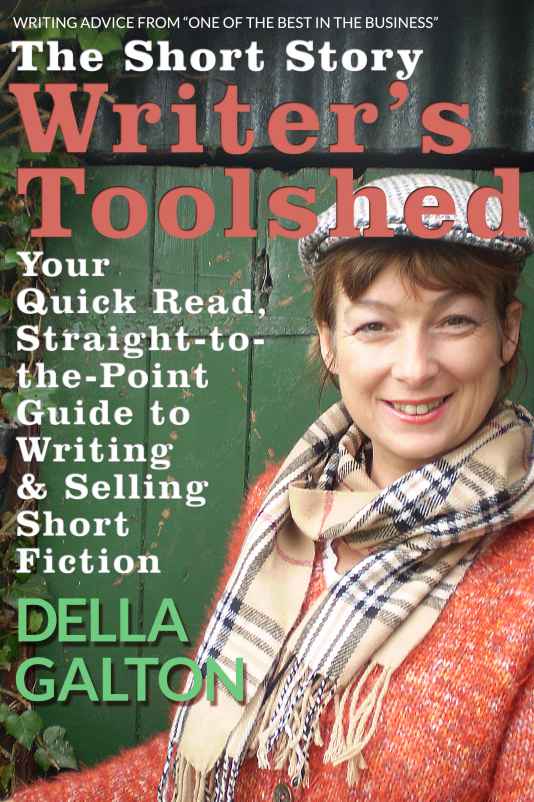
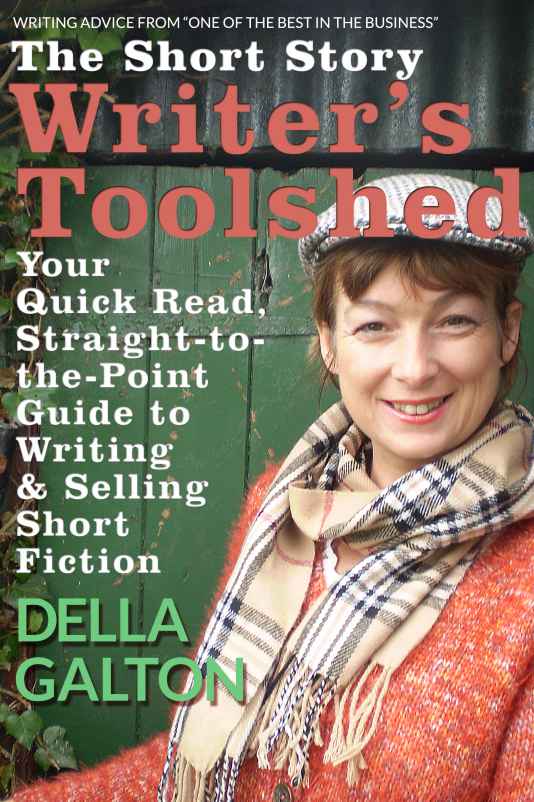
Thank you for reading. For more tips on characterisation, please see my book, The Short Story Writer’s Toolshed. Currently on sale at Amazon for just 99p.
Writing for The Friend

Last week I was lucky enough to listen to a talk – as well as have a chat with – Shirley Blair, Fiction ed of The People’s Friend.  Fascinating stuff.  Here are ten things you may or may not know about writing for The Friend.

  1. They buy 633 short stories a year – 641 if you count long reads. That’s 17 a week. Which makes them the biggest consumer of women’s short fiction and a very good market to try.
  2. They read everything they receive because they never know when they will find the next diamond.
  3. They are traditional and have a hardcore of readers who are easily offended – the ones who express dismay that consuming alcohol has become commonplace in fiction.
  4. Hence, they like to offer in their fiction, escapism, comfort, the feel good factor rather than the harsher edges of reality. Think reality in soft focus.
  5. This does not mean they want boring and same old.
  6. They like young romances.
  7. They like feel-good.
  8. They like to be entertained.
  9. They like a positive outcome.
  10.  Stories they see too much of are:
    1. Old lady who is scared of young people. Really???
    2. New widow thinking about sheltered housing, even though she is only 60.
    3. Empty nester seeing daughter off to university.

So, there you have it? Think you could write for The Friend. They have a website and a blog and are very active on Facebook and Twitter. Why not give them a go. And please give my love to Shirley.

And here’s a quick cheeky plug for my book about writing short stories. The Short Story Writer’s Toolshed. Click here to check it out. 🙂


Creating Suspense in Short Stories – Three Top Tips

I used to believe that the art of writing suspense was mostly about technique – short sentences build tension and pace, longer sentences slow it down. But suspense means so much more than this. So what does the word suspense actually mean?

Maybe I won’t tell you yet…

Just kidding, but, according to the Oxford Dictionary, suspense is a noun and it means:

A state or feeling of excited or anxious uncertainty about what may happen

So how do we create this in our writing? Here are my top three tips:

1. Pose questions, but do not answer them. As soon as you answer a question the suspense is gone.

Here is the beginning of A Table for Four, a story I sold recently to My Weekly.

What should I wear? I looked at the clothes laid out on my bed and sighed. There was a part of me that didn’t really want to go to this reunion lunch. I didn’t want to face all that emotion, all that honesty. I didn’t want to be reminded of the past. And it was going to be odd without Alice. It was the first year that we had met without her.

There are several questions in this opening paragraph. What should the narrator wear? What sort of reunion is it? Who’s Alice and why isn’t she there this year?

In order to create suspense – they should not all be answered in paragraph two. In fact, it’s a good rule of thumb to make sure you never answer a question without posing another one.

2. Withhold Information – for as long as you possibly can without being annoying.

Paragraph two of A Table for Four

For a moment I let an image of her face fill my mind. Her sparkly blue eyes, her ever present smile. I’d loved Alice to bits. I don’t think I’d have got through my surgery or those endless hospital visits without her irrepressible brightness.

Cue flashback.

“Chin up, honey,” she’d say if I’d moaned about my hair falling out. “You’re not going to miss a bit of grey hair, are you?”
“It’s not grey, you cheeky mare,” I’d snap, and she’d click her tongue and shake her head. “You’re smiling though!”
It was amazing how you could joke about the darkest of things. It had often surprised people – family and friends – when I’d told them how much laughter there had been on Marshall Ward.
I had to go to the reunion. Besides, I wanted to find out how everyone else was.

So now we know a bit more about Alice – but we still don’t know who she is – or where she is – or exactly what’s going on here, although we are slowly being given more information.

3. Use Foreshadowing

I don’t mean the type where you say, she had no idea that tonight would be the last night of her life. Although that might well create suspense, it’s a bit clunky and amateurish. Instead, set up a scene or situation where you don’t explain something that will crop up later. Here’s a paragraph a little later in A Table for Four.

The waitress came for our order.
“Are you still waiting for someone?” she asked, glancing at the empty space beside me.
I shook my head, but when she moved to clear the surplus knife and fork, I stopped her. “Please could you leave them?”
“Er – yes, sure…” The waitress looked puzzled but no one enlightened her.

In this way although the reader might well guess that the fourth place is for Alice, they won’t know for sure why the others want it left, even though she isn’t coming.

The art of writing a good short story is to keep the reader guessing. Indeed if you’re writing a twist you need to keep them guessing until the very end. It’s the same with all writing. If you’re writing a novel or novella you have the luxury of cliff hangers too – don’t just keep them for chapter endings – use them for scene endings.

At the end of your short story the questions you’ve posed need to be answered. For example at the end of A Table For Four – we find out why a place has been set for Alice, even though she isn’t coming, and where she actually is. And there’s also a little twist. I’m afraid I can’t reveal the end as I don’t think this story has been published yet. If the suspense is really too much – email me privately and I’ll tell you!

PS in other news: my novel, Ice and a Slice is on Kindle Countdown. Between Friday 27th June and Thursday 3rd July it’s only 99p instead of £1.99.

Woman’s Weekly Fiction Workshops – Hot Tips

A couple of Fridays ago I was teaching again with Gaynor Davies at the Blue Fin Buildings, our subject, Writing Short Stories for Woman’s Weekly. I thought you might like an update. There are two more short story workshops planned at IPC, by the way, 15 August and 1st September 2014, click here for more details and as they are so popular I’m also in discussion with Gaynor about doing another one this year, probably in October. So don’t worry if you can’t get to one of these.

In the meantime for those who can’t make a workshop, here are a few tips from myself and Gaynor hot off the press. I must point out these are my tips, as I understand them, not direct quotes from Gaynor. (Just in case any of the Woman’s Weekly team are reading).

  • When Woman’s Weekly first came out their aim was ‘To be useful and not deal with the sordid side of life’.  An old adage which still holds true today.  But do be contemporary.
  • Today’s fiction should be escapist, but also believable.
  • Many stories are rejected because they are too old fashioned.
  • They need stories that have an individual voice so don’t copy the style of previously published stories.
  • They also want variety.
  • They are always looking for more humour.
  • Most popular lengths are one pagers (900-1000) and two pagers (1800-2000)
  • You can go up to 8000 words for the special and (top tip) they don’t get many of these.
  • On a technical level – keep the style simple. Cut adverbs and don’t get too wordy. The verb of speech ‘said’ is fine. Characters don’t need to exclaim, explain and expostulate.
  • Remember that imagery is good but too many images can cancel each other out.
  • Woman’s Weekly stories must have a proper ending – you don’t have to tie up the ends in a neat bow, but stories can’t be completely open ended either.

In the latest Woman’s Weekly Fiction Special (May – on sale 1st April to 6th May) I have a short story called By The Book (page 24 if you’re interested.) By The Book is a light romance about online dating. I don’t do many romance stories, mainly because it’s so hard not to get predictable. I was inspired however to write this story by Peter Jones’ latest book How to Start Dating and Stop Waiting which is very entertaining and also a brilliant guide to internet dating.

Woman’s Weekly are also very keen to get new serial writers. Serials go up to five parts, which is a lovely length if you want to write longer than a story but aren’t ready for a novel. The current one, called Amos Browne by Leonora Francis is excellent. If you would like to look at another example of a serial you could try my latest novella Shadowman, which was once a serial in Woman’s Weekly but is now having a second lease of life as a novella. If you buy it in the next day or two it’s only 99p too – as it’s on an Amazon Countdown promotion can’t say fairer than that!

And as I’m in ‘shameless promotion’ mode, if you’d like to read any more short stories by yours truly please do check out my collection of Daily Della titles, for example, Lessons in Love which is just £1.53. All of my Daily Della stories were previously published in magazines so they will give you a flavour of the type of story required.

There is a fabulous roof top terrace canteen at Woman’s Weekly, by the way, which does amazing shortbread – just in case you were still trying to make up your mind on whether to book up for a course.

If you’d like to know any more about the art of writing short stories, please also check out my Short Story Writer’s Toolshed which is £1.99 for kindle.

Thank you for reading. And here’s hoping none of our stories stay in the cupboard (see previous blog, journey of a woman’s weekly story) for long!

The Journey of a Woman’s Weekly Short Story – from arrival to publication

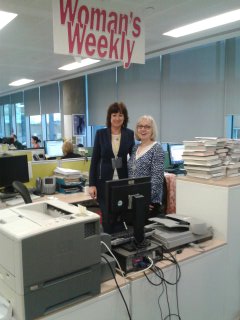
Last Friday I was lucky enough to be teaching at Woman’s Weekly’s offices in London with Fiction Editor, Gaynor Davies.  While I was there, I thought it would be very interesting to find out exactly what happens to our stories when they arrive. So if you have ever wondered what happened to your manuscript after you posted it – here is the journey of a Woman’s Weekly Short Story.

Woman's Weekly

Step One. All manuscripts are logged in date order and put in this cupboard.

The Manuscript Cupboard

Step Two. They are sorted out and read. If you have been published by Woman’s Weekly before they will be read ‘in house’. If you have not they will be sent out to two very experienced readers who Gaynor says she trusts with her life.

Step Three. If your story is a near miss or a possible it will be sent back to Clare for a second read.

Step Four. If Clare likes it, she will pass it to Gaynor Davies, fiction editor.

Step Five. If Gaynor likes it she will pass it to Diane Kenwood, the editor for a final read/approval. Which is hopefully followed by a yes.

Step Six. If it’s a yes, Clare will contact you by phone or email to tell you the good news.

Of course, a ‘no’ can happen at any stage of this process.  If it’s a ‘no’, you will have an email from Maureen Street.  Now it has been rumoured that Maureen Street doesn’t exist. That she is just the pseudonym or ‘fall guy’ if you like – the made-up person who sends the rejections.  I can confirm she does exist and she is a very very nice lady. Here she is with Gaynor.

Gaynor Davies (left) Maureen Street (right)

And here are the two desks where so many decisions regarding the fate of our stories are made 🙂

So now you know!


Gaynor's desk (closest) Maureen's desk (by window)


Four Myths About Writing Short Stories for Magazines

Writing stories for magazines is easy – right?

Er – no – we all know that’s a myth. If you’re reading my blog, then chances are, you’ll know it from personal experience.

Once you have sold a few stories to magazines, they just buy everything you send – right?

Er – no – they still only buy the ones they think are perfect for them.

If an editor asks you to rewrite a story, they will then buy the resulting rewrite, won’t they?

Er – no – they wont, not unless it’s perfect for them second time round, or third, or fourth.

Once you break in there’s loads of money in it.

Er – no!

Just to illustrate these four points – and one more very important point I thought I would share with you the journey of a magazine story I wrote. Out of courtesy I’m not going to name the actual magazines mentioned in the following examples. I will give them pseudonyms, so please don’t think there are four new magazine markets out there you haven’t heard of -there aren’t – but the actual facts are true.

On 8 December 2011 I wrote a story (let’s call it A Special Day) and sent it to that ‘well known magazine’ Women Everywhere. On 20 January 2012, their editor sent it back saying they liked the story but not the ending, could I possibly rewrite it and they’d take another look.

“Of course,” I said, and offered them A Special Day mark two on 26 January, 2012. A week later they sent it back saying, sorry, we’re not keen on this ending, please could you try again.

“Of course,” I said, and offered them A Special Day mark three on 17 February 2012. A week later they sent it back saying, sorry, we’re not keen on this ending either. Thanks for trying.

“Thank you for giving me the opportunity,” I said, and (not to be deterred) on 12 March 2012 I sent mark three of my story to another well known magazine called Women Worldwide.  

They ignored it for several months. I didn’t chase it, but on 24 January 2013 I sent a different version (mark two) to Women Worldwide, with a note mentioning they’d had a previous version, but this was new and improved. A month later they sent back the new and improved version with a polite rejection.

Not to be deterred – I’m quite stubborn, me – I looked at all my versions and decided that the mark two version was the best and I sent it to another well known magazine, let’s call them, Universal Woman.  A week or so later they sent it back with the comment, we enjoyed this but it’s not for us.

Again, not to be deterred – did I mention I was stubborn? – I sent the mark two version to yet another magazine called All Women on 5 March, 2013. On 8 May, 2013 they sent it back with the comment, “We quite like this, but could you change the end?”

“Of course,” I said, and rewrote the end for the fourth time (yes there was actually an ending I hadn’t thought of yet) and I resubbed it on the morning of the 15 May, 2013.  On the evening of the 15 May, their editor came back to me and said, “Yes please, we’ll buy that one.”

“Thank you very much,” I said. “That’s excellent news.”

Alleluia might have been a more accurate description of what I was feeling at that moment. That story had started life in December 2011, had been given four rewrites and finally sold in May 2013.

This kind of thing doesn’t happen all that often, thankfully, but it’s not unheard of, and I think illustrates quite well what I mentioned earlier. Writing for magazines is not easy, it doesn’t matter how many they’ve bought from you before it doesn’t mean they will buy your next one, and they won’t necessarily buy your 2nd or 3rd rewrite, even if they ask you to do them. And – no I did not get paid a fortune for the story when I finally sold it. But I did get paid!

I would like to end on a note of hope. If you really do think a story has got what it takes, then don’t give up on it.  There is every chance you will sell it eventually. And it is – I have to say – very, very very satisfying when you do!

If you would like to know more about writing and selling short stories – please do check out my book, The Short Story Writer’s Toolshed here.

Issue Led Stories

Issue led stories are controversial – or can be? Should we write them? Especially for magazines. Or should we stick to nice safe subjects like weddings and car boot sales and summer balls. Not that I’ve got anything against these subjects, I think I’ve sold stories about all of them – well possibly not a summer ball, must put that one on my list!

But – and I think I might have mentioned this – I also like writing about issues. Gritty issues. My students often ask me if there are any subjects that are taboo for magazines and the answer is that, no, I don’t think so.  Well maybe some subjects are taboo for some magazines, but I’ve written lots of issue led stories. I’ve written (and sold) stories about: abortion, agoraphobia, anorexia, alcoholism (did I mention I just wrote a book about alcoholism called Ice and a Slice).  Check it out here. You can even read the first chapter on the previous blog. I will shut up about Ice and a Slice soon, I promise!

I’ve also written about the death of pets or people, drugs, sexual abuse, nervous breakdowns, cancer, prisons – I’ve even slipped the odd quite saucy story past a magazine editor!

I think the key to writing issue led stories and selling them to magazines is to do it sensitively and also to give some hope. If you write about a gritty issue and then give it a really sad ending this might not be so successful.

You can of course write stories with more downbeat endings for competitions. But don’t be depressing even if you’re being downbeat.

I’ve just had one of my issue led stories (about anorexia) published on Morgen Bailey’s blog. If you’d like to check that out, please do take a look. Click here. It’s Flash Fiction so very short. In fact, I think that Flash Fiction works very well if you use a strong, gritty subject.

I’d love to know what other writers think.


Market Research – it’s a bore, but if you want to sell more!

Market research is a lot simpler than it sounds. If you want to sell short stories then you need to find out who buys them and what they are looking for.

Do research your market before sending anything. Read several stories in the magazine or other market you intend to write for.  I find it helps to tear them out and lay them side by side.  It’s much easier to see style, length of sentences and the language used.

The age of your market’s readership is very important.  Your story should reflect the interests of your target reader.  Adverts are a very good indicator.

Check to see if your editor prefers first or third person viewpoint.  Do they take male viewpoint, double viewpoint, narrative viewpoint?   In my experience most editors do have a preference.

Try to be different without going outside the parameters.

Don’t send more than one story in the same envelope.  A My Weekly editor once told me that if she receives two or three stories in an envelope from the same author, she will automatically grade them in order of merit and if she is going to buy, will buy the best one.  The stories would have to be outstanding for her to buy more.

By all means send more than one story to a magazine, but not in the same envelope and not at the same time.  A week or so between each one is about right.  Having several stories out at a time lessens the pain of rejection.

Keep records so that you know where your work is, date sent etc.  I decide before sending a story out for the first time, exactly where it will be going for the first few markets. I sell 40% of my work first time out.  Overall, I sell approximately 94% of the stories that I write.  If I gave up after the first time out, I wouldn’t be able to make a living.

If a story comes back from the first market you try, it may well need re-writing for market number two.  People’s Friend and Take A Break have very different requirements.

Rewrite, particularly if an editor comments.

There are various levels of rejection slip.  A plain compliments slip from the editor with nothing written on it is probably about the worst.  If you are getting close, many fiction editors will tell you. D C Thomson editors often send out what they call a “see more” letter, i.e., we would like to see more of your work.  If you get one of these letters, follow it up with a new story as soon as possible.

Up your game – come on my How to Write and Sell Short Story course on Saturday 9 March in Bournemouth. Details on the courses page of this website. Why not email me for more details.

The only way to avoid rejections is the also the only way to avoid success.  Do not send anything at all.  That way you can proudly tell everyone that you haven’t a single rejection in your cupboard.  For the record, I have hundreds. I have never met a successful writer who hasn’t.  Good Luck.


So what is a short story then?

This is a question I regularly get asked by students. I was doing a talk at a writers’ group in Bournemouth on Monday evening and it came up again.  I know I have my own definition, it’s one I’ve refined and honed over the years, and it’s this:

A short story is a piece of writing where a character has a problem, which is resolved by the end in an unexpected way, preferably by the character’s own endeavours.  During the process the character is changed in some way.

There does not have to be a twist, but the problem can’t be resolved so simply that there was never really a story.

I don’t really think about this definition when I’m writing a story, but what I do find interesting is this. If I’m struggling with a story that isn’t working, it’s usually because one of these elements is missing.  Perhaps there is no problem, for example. Or perhaps it’s resolved by someone else, or perhaps the resolution is too obvious.

There are other definitions, other elements, like themes and universal truths that come into play, but this definition has stood me in very good stead.

If you want to know more my next two courses are about short story writing

Write a short story in a weekend takes place at Fishguard 15th – 17 February

http://www.writersholiday.net/fishguard.htm

I’m also teaching How to Write and Sell Short Stories in Bournemouth on Saturday 9 March, 13.

http://www.dellagalton.co.uk/?page_id=31

Speed Short Story writing

How many short stories can you write in a week? How many in a day? I’ve just read a feature in Writing Magazine,  October Issue, about a guy who wrote, edited and formatted a novella length story in a week.

Did it suffer for being written fast? Is it possible to write good fiction fast? It got me thinking.

When I first started writing full time in September 2000, I wrote three short stories a week. The first one on Monday morning, the second on Monday afternoon, and the third on Tuesday morning. I edited them across the week. I did this every single week without exception. Holidays – pah! who needs them!

I also taught four creative writing classes, one on Wednesday morning, One on Thursday morning, one on Thursday afternoon and one on Friday morning. These all needed preparation too. Hence I had to cram the short stories into the earlier part of the week.

Did my work suffer for this? I don’t think so. I’m judging this by the yardstick of sales and I sold 90% of my work.

Interestingly, this pattern of working has changed across the years. I haven’t written three short stories a week for a while. I’ve been doing other things, for example, writing novels and non fiction, editing for a publisher, as well as teaching, although interestingly I only now teach two classes a week. I must be getting lazy 🙂

But this week, I reverted to my original working pattern. I wrote one short story on Monday morning, one on Monday afternoon and one today.

They were – in case you are interested – 2400 words, 1000 words and 2300 words respectively. Although that might change on the edits.

Oh it was so brilliant, so exhilarating, so exciting. I haven’t felt so inspired or motivated for absolutely ages. I’m not sure why. Is it something to do with speed writing. Is this speed writing. It certainly was compared to what I’ve done lately.  But the ideas for more short fiction are also coming thick and fast. It feels brilliant.

I will let you know if I sell them. But does anyone else write like this. Do share.

Della xx


Tell your friends!

© Della Galton All rights reserved.
Powered by Cloudbase Media