Welcome to Della Galton’s website

Speed Short Story writing

How many short stories can you write in a week? How many in a day? I’ve just read a feature in Writing Magazine,  October Issue, about a guy who wrote, edited and formatted a novella length story in a week.

Did it suffer for being written fast? Is it possible to write good fiction fast? It got me thinking.

When I first started writing full time in September 2000, I wrote three short stories a week. The first one on Monday morning, the second on Monday afternoon, and the third on Tuesday morning. I edited them across the week. I did this every single week without exception. Holidays – pah! who needs them!

I also taught four creative writing classes, one on Wednesday morning, One on Thursday morning, one on Thursday afternoon and one on Friday morning. These all needed preparation too. Hence I had to cram the short stories into the earlier part of the week.

Did my work suffer for this? I don’t think so. I’m judging this by the yardstick of sales and I sold 90% of my work.

Interestingly, this pattern of working has changed across the years. I haven’t written three short stories a week for a while. I’ve been doing other things, for example, writing novels and non fiction, editing for a publisher, as well as teaching, although interestingly I only now teach two classes a week. I must be getting lazy 🙂

But this week, I reverted to my original working pattern. I wrote one short story on Monday morning, one on Monday afternoon and one today.

They were – in case you are interested – 2400 words, 1000 words and 2300 words respectively. Although that might change on the edits.

Oh it was so brilliant, so exhilarating, so exciting. I haven’t felt so inspired or motivated for absolutely ages. I’m not sure why. Is it something to do with speed writing. Is this speed writing. It certainly was compared to what I’ve done lately.  But the ideas for more short fiction are also coming thick and fast. It feels brilliant.

I will let you know if I sell them. But does anyone else write like this. Do share.

Della xx



Wacky Filing Systems

I always find it interesting what other writers do to keep track of their stories. I know some of us have paper filing systems (I do) and some of us keep track of our stories on spreadsheets.

I prefer the paper filing systems because when I finish writing and editing a story which I do direct on to the computer, and then I send it out, which I tend to also do by email, I quite like to sit and fill in a paper record.  I know, I’m odd like that!  For every story I ever write I keep a blank postcard. It has the title at the top of the card and the number of words, and then below this, I write down the markets where this story will go, for example, Woman’s Weekly, Take a Break etc. Then I list the date sent on the first market and when the story is either sold or returned I list the date again, with any comments.

Recently I ran out of white postcards, so I decided it would be fun to get some different coloured postcards and colour code my stories. So now I have:

Yellow – humorous stories

Blue – emotional stories

Green – twists

Pink – romance

I know, I am quite mad. but it’s quite good fun, watching the colours build up in my index card filing box and seeing how many of each type I write. 🙂

Does anyone else do this?


How to Write and Sell Short Stories in a Changing Market

Shameless self promotion below 🙂

I am doing a course called: How to write and sell short stories in a changing market – Saturday 20 October, 10 till 4.00 in Bournemouth.

Is the short story market dead? I don’t think so. Although you may have to think a little laterally to find good markets. This course will focus on writing short stories for some of the new as well as existing (paying) markets currently open to submissions.
(Suitable for beginners and experienced writers)
Cost: £35.00

There will be workshops 🙂

Please email me or reply to post for further details.

Thanks

Della


Battersea Dogs and Cats Home

I recently did a feature for the People’s Friend about Battersea Dog and Cats Home to tie in with  ITV1’s series, Paul Grady: For the Love of Dogs.  The feature comes out in People’s Friend on October 20th, but in the meantime here are some of the rather lovely pictures that were taken by a friend who went with me.  Thank you, Peter.


One of the saddest statistics, at least for me, was that 37% of all the dogs in Battersea are Staffie Crosses. This is Jacob who was at the time of my visit, Battersea’s longest serving resident!

I have a Staffie Cross called Rosie. Here she is.

Rosie is an ASBO dog – she doesn’t like other dogs. She was brought up by a man who thought it would be fun to teach her to fight. Now, despite consulting various experts  she has to be walked separately on a lead from my other dogs and preferably when there is no one else around.

I wrote this poem for Rosie and all the other ASBO dogs and owners out there who have to go out before dawn if they want a peaceful walk.

 ASBO Dogs

 There’s an underworld of dogs,

they come out before the dawn,

when the city streets are dark still,

and there’s frost on every lawn.

They’re the growlers and the snappers,

and the ones that start the fights.

They haul their owners round

beneath the avenues of lights.

They tread in endless circles,

and they don’t come face to face.

Wearing harnesses and muzzles

in some endless pre-dawn race.

There’s an underworld of dogs,

called the monsters and the pests.

The biters and the fighters;

they can’t mix with all the rest.

Their owners are pariahs, they

side-step each other madly.

A wave across a football pitch

’cause dogs behaving badly!

Their owners are the saviours,

And the only ones to go

To the last chance sanctuaries,

where the dogs are on death row.

There’s an underworld of owners,

who gave up an easy ride,

for the hassle of an ASBO dog,

snip-snapping by their side

There’s an underworld of dogs,

who’d never chase another ball.

Without an underworld of owners,

they would never live at all.

© Della Galton, 2012


The Fleetingness of Beautiful Things

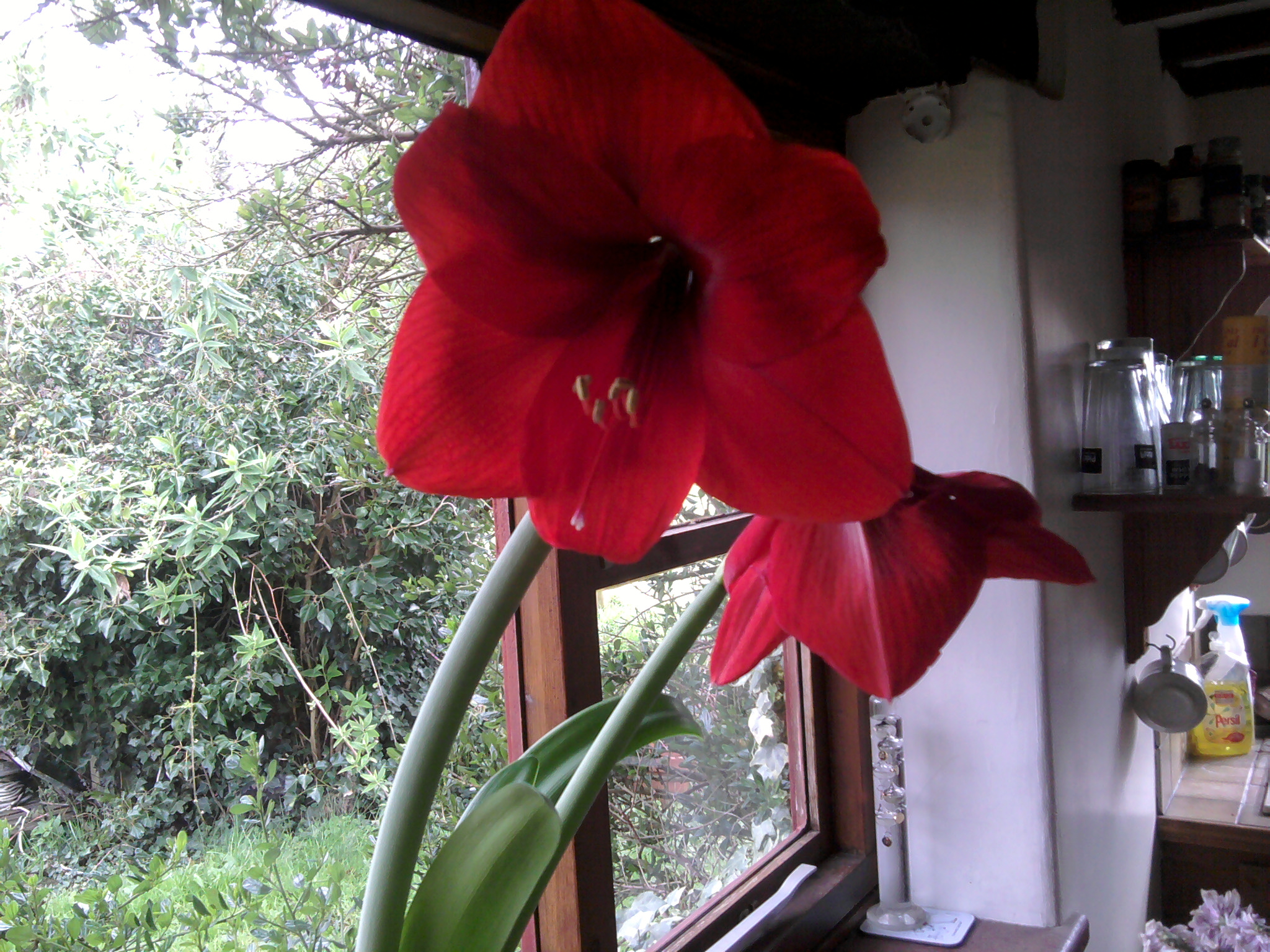
This is a picture of my amaryllis – or to be more accurate, Adam’s amaryllis, which is in our kitchen. It flowers twice a year if I’m lucky. The flowers last for about a week. And then they die.  Isn’t it stunning?

My Amaryllis

And isn’t it sad that it is so fleeting.

And it got me to thinking about other fleeting and beautiful things. Like sand sculptures that will be washed away by the next tide.

And what a good emotion that is – that beauty that you cannot keep – for writing a short story.

As fleeting as a short story itself, maybe!

So I wrote one.  I wonder if anyone will buy it.  And what are the fleetingly beautiful things that stir other writers to create?

I would love to know.


Writing Flash Fiction

I’m running a day course on writing flash fiction soon, Saturday 28 April in Bournemouth if you’re interested!  There are more and more competitions and markets for it – so what is it exactly?

This is harder to define than you might think.   Some people define it as anything less than 1000 words, but I don’t agree that 999 words is flash fiction – not in today’s market anyway.  1000 words – is loads!!!

My instincts tell me it’s fiction of less than 500 words – or is it 250?  The Bridport competition has a flash fiction category of this length.

I used to belong to the Bournemouth Writers’ Circle and they ran a competition every month called the Have A Go competition. It had different themes and the max length was 250 words.  What a brilliant, brilliant training ground this was.

Or perhaps flash fiction is less than 100 words – there are competitions for this length too – or maybe even 60 words.  Both Woman’s Weekly and Chat magazine used to publish 60 word stories.   Then there are the 6 word stories. The most famous being Hemmingway’s, ‘for sale, baby shoes, never worn.’  That always sends a shiver down my spine!

Personally I’ve always thought that the very short fiction 100 words or less is micro fiction.

But, enough of my pondering on length.  Regardless of number of words, what Flash Fiction should be is a complete, stand-alone story, just like its elder brothers and sisters. It shouldn’t be an extract. It should have a beginning, middle and end.

I think that twists work well for flash fiction and I also think powerful stories work well.  It’s very hard to write ‘light’ flash fiction and get it to work.

I also think it’s immensely good fun to write to short lengths.  And there are lots of markets for it these days too.

More on flash fiction coming soon. And if you would like to spend a day focusing on this length and hopefully go away with a story written, then don’t forget my course in Bournemouth on Sat 28 April!

More details here.  http://www.dellagalton.co.uk/?page_id=31

How To Get An Original Idea

One of the things short story competition judges bemoan the most is that they hardly ever see an original story, or a really original idea.   Yet being original is one of the fastest ways to get into the shortlist.  Providing you can also write well, of course!

Is there actually such a thing as an original idea?

Maybe not.  But there are a lot of things you can do to make your story stand out from the crowd. Especially if the competition has a theme.  Here are my tips for finding an idea that’s different:

For the purpose of this exercise we’ll assume the theme of our imaginary competition is Loss.

So the first thing you should do is to write down all the ideas that spring to mind when you think of the theme loss.  These are mine. Some of them might be yours too.

Loss of job

Loss of spouse

Loss of child

Loss of house

Loss of pet

Loss of life

Loss of bag

There is a good chance that everyone else will think of these ideas too, so unless you have a really original slant, move on and list some more.

Loss of limb, finger, toe, eye

Loss of liberty

Loss of memory

Maybe we’re getting a few ideas that are a bit more lateral.  But let’s go on.

Loss of an identity (Alzheimer’s or another reason)

Loss of a parrot – or another unusual pet, think snake or hippo, or how about something mystical, a unicorn

Loss of a generation

Loss of a culture

Loss of a precious artefact

Hopefully there won’t be many stories with the above losses and I’m sure you can think of lots more. But let’s make it a bit more unusual.

What if you used a different structure as well? What if you used a diary structure, for example. I read a brilliant story recently (in a competition I was judging) where the author had used a diary structure, but, just as in the Time Traveller’s Wife the dates weren’t chronological.

Or you could tell your story entirely through taste, or smell, or perhaps dual viewpoint.

Or you could link the scenes with the same setting, for example the sea.

The diary story won the competition I was judging by the way!

Food for thought!

What should be on the first page of your novel?

The first page of your novel has to be excellent. If it is not first class, then it’s possible the agent or publisher you have targeted will not read any further.  Time is money, and they will only be interested in your novel if they can see its potential very quickly.  So it goes without saying that the writing must be as good as you can make it.

OK, so the writing is good, but what else should your first page contain?

Having carried out some research on this subject (I analysed a selection of best selling novels) I’ve collated a list of elements that a successful first page is likely to contain. So here they are:

A hook

There must be enough of a hook to make the reader want to turn the page, and, indeed, get past the first paragraph.  This does not have to be dramatic.  That will depend on the type of book you’re writing, but you should try to engage the reader immediately.

At least one character

This won’t necessarily be the main character, but it usually is the main character or someone closely connected to them.  If it isn’t, you should have a good reason.

Place

Whilst the setting doesn’t have to be spelt out, and this is often not possible, there should probably be some indication.

Time

Is your novel contemporary or historical?  It’s a good idea to indicate this fairly early on.

Genre

We should also be able to tell the genre of the novel very quickly.  Not necessarily from the first page, but do begin in the style in which you are likely to continue.   If the novel is humorous, you might not necessarily have an hilarious event on the first page, but the genre should be reflected in the style of writing.

Dialogue

Not all first pages contain dialogue. For example, first person novels often don’t need it, but it isn’t a bad idea to introduce dialogue quickly.  The sooner the reader hears your characters speak, the sooner they will start to care about them.  Or not – as the case may be.

Descriptions of characters

Again, these do not necessarily have to be on the first page, but if you are introducing a character without giving the reader any hint of what they look like, then the reader may well formulate their own view.  If you later contradict this, i.e. the reader assumes your character has brown hair and they actually have flaming red hair there is a danger of losing reader identification.

Summary

And finally, you will need to do these things without it appearing in the least contrived. This is no mean feat, I’m sure you’ll agree.

The good news is that it’s probably not worth worrying too much about your first page until you have completed the novel.  In my experience, the first page I originally write for a novel is rarely the first page I end up with.  Therefore it makes no sense to worry too much about it until you have completed a draft. It is pointless to edit and perfect something that you might later discard.

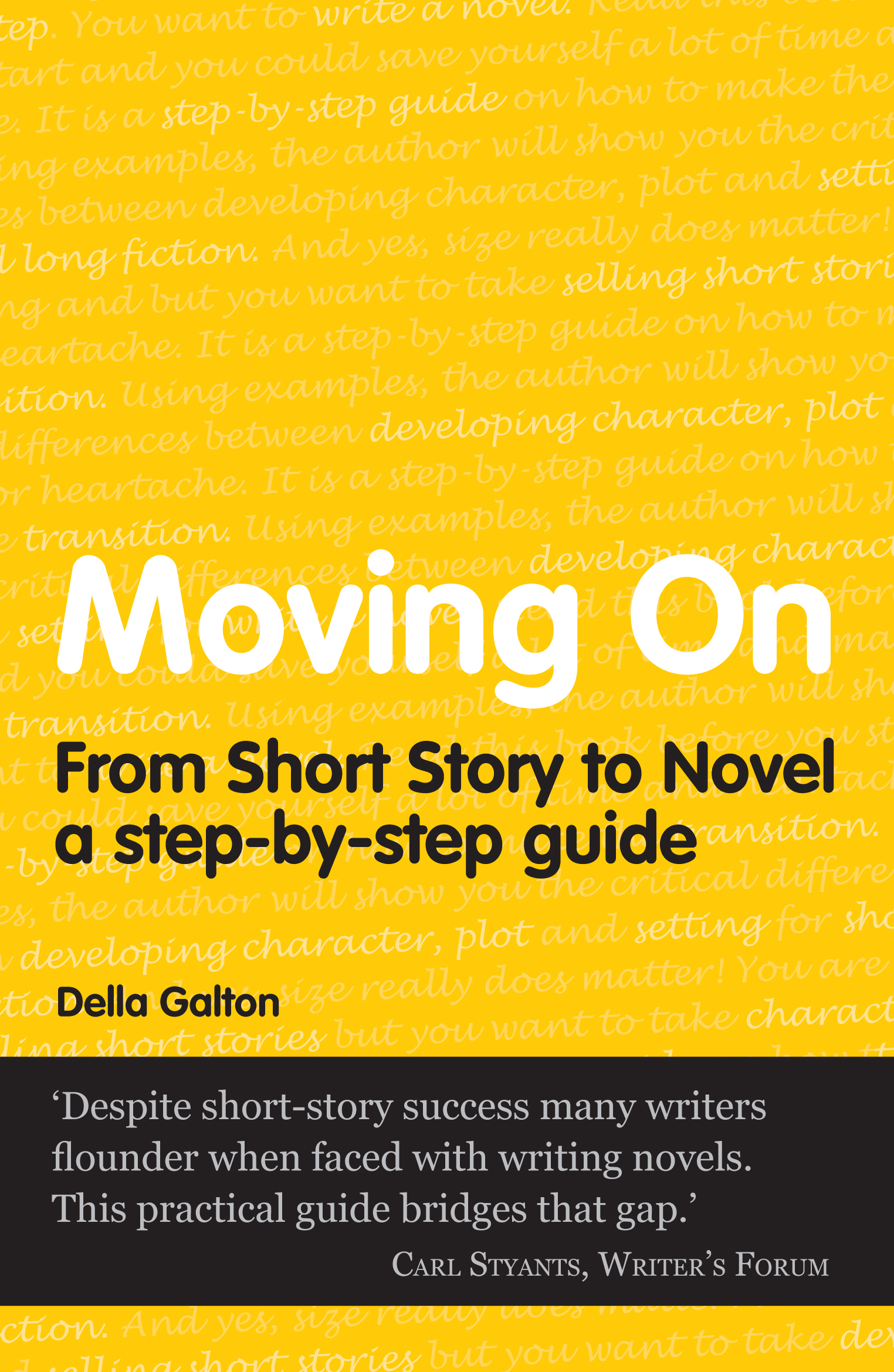
Incidentally, if you’re interested, there’s more on this subject in my book, Moving On – From Short Story to Novel, published by Accent Press. Price £9.99


Today is Publication Day!

Today (January 5th, 2012) is publication day of my new book, and I am so excited.  Even though I know everyone else in the universe won’t know and won’t care and the momentous news will pass without comment. But I am bursting with pride, and I feel a huge sense of achievement.

I wrote this book because I needed it when I wrote my first novel, and I needed it when I wrote my second, third, fourth, fifth, sixth and seventh novels…. And it wasn’t around.  So I thought I should write it!

Actually, I was a bit scared of taking the huge leap between writing short stories and novels. And, rather strangely, the more I learned about writing, the more scared I was – it isn’t a straightforward transition, at least it wasn’t for me!

I have sold my work for 25 years now, and yet each time I venture into a new type of writing, whether it is feature, or serial or poetry or radio play or children’s story, or humour, or erotica or full length non fiction or novel, I feel for a little while, as though I am stumbling around in a darkened house. There are no lights, no signposts, no familiarity.  And I have had success with writing, and I know the techniques, I know the craft, but that doesn’t mean I am not afraid.

I literally feel my way.  Going from the short story to the novel was the biggest leap for me.  I wrote my first novel knowing nothing whatever about the form.

By the time I wrote my fourth, Passing Shadows, which was the first one I sold, I felt as though the lights in the house were on – but I still had so much to learn.

What did development of characters mean? What did it really mean? How much plot did I need? What were the differences in real terms? Were there a lot of differences?

Oh yes, there were.

This is why I wrote this book.  I hope my experiences will help you.  I love teaching almost as much as I love writing and I wanted to share my journey with other writers who are also making the move from short story to novel.

Moving On – from Short Story to Novel – A step by step guide is the result.

Thank you for all the writers who shared their experiences with me on their moving on writing journey.

With love

Della Galton


Della Galton is the author of six novels, and three non-fiction books. Her short stories have been published in every major UK women’s magazine, as well as numerous short-story anthologies (available from Accent Press). She is Agony Aunt for Writer’s Forum magazine, and teaches at various writing courses and workshops around the country. Moving On – from Short Story to Novel – A step by step guide by Della Galton, is published by Accent Press, price £9.99.
Find out more about Della at dellagalton.co.uk.

Click here to purchase ‘Moving On’ from Amazon.co.uk

Click here to view all of Della’s books on Amazon


Dear Della Questions

Had some great questions today in Dear Della, including one from a writer who was despondent because she’d had quite a few rejections for her first novel.

We all know how that feels, I know I do.  Maybe writers are masochistic. How many professions are there that involve working flat out for a year, pouring your heart and soul into something, and then trying to sell it and finding that the rest of the world doesn’t share your passion?

Out on January 5 but available to pre order now. A late Christmas present perhaps!

And we don’t just do it once, do we? Oh no, we carry on, year in, year out with this impossible dream. I wrote four novels before I found a publisher for number four.

On a happier note – my brand new non-fiction book is just about to go to print.  Here is the cover. I am so thrilled with it.

I don’t think there is anything else like it on the market because while there are heaps of books aimed at writing your first novel, not many of them show you the actual ‘differences’ between short stories and novels.  I discovered via painful experience that there were lots.


Tell your friends!

© Della Galton All rights reserved.
Powered by Cloudbase Media