I used to believe that the art of writing suspense was mostly about technique – short sentences build tension and pace, longer sentences slow it down. But suspense means so much more than this. So what does the word suspense actually mean?
Maybe I won’t tell you yet…
Just kidding, but, according to the Oxford Dictionary, suspense is a noun and it means:
A state or feeling of excited or anxious uncertainty about what may happen
So how do we create this in our writing? Here are my top three tips:
1. Pose questions, but do not answer them. As soon as you answer a question the suspense is gone.
Here is the beginning of A Table for Four, a story I sold recently to My Weekly.
What should I wear? I looked at the clothes laid out on my bed and sighed. There was a part of me that didn’t really want to go to this reunion lunch. I didn’t want to face all that emotion, all that honesty. I didn’t want to be reminded of the past. And it was going to be odd without Alice. It was the first year that we had met without her.
There are several questions in this opening paragraph. What should the narrator wear? What sort of reunion is it? Who’s Alice and why isn’t she there this year?
In order to create suspense – they should not all be answered in paragraph two. In fact, it’s a good rule of thumb to make sure you never answer a question without posing another one.
2. Withhold Information – for as long as you possibly can without being annoying.
Paragraph two of A Table for Four
For a moment I let an image of her face fill my mind. Her sparkly blue eyes, her ever present smile. I’d loved Alice to bits. I don’t think I’d have got through my surgery or those endless hospital visits without her irrepressible brightness.
Cue flashback.
“Chin up, honey,” she’d say if I’d moaned about my hair falling out. “You’re not going to miss a bit of grey hair, are you?” “It’s not grey, you cheeky mare,” I’d snap, and she’d click her tongue and shake her head. “You’re smiling though!” It was amazing how you could joke about the darkest of things. It had often surprised people – family and friends – when I’d told them how much laughter there had been on Marshall Ward. I had to go to the reunion. Besides, I wanted to find out how everyone else was.
So now we know a bit more about Alice – but we still don’t know who she is – or where she is – or exactly what’s going on here, although we are slowly being given more information.
3. Use Foreshadowing
I don’t mean the type where you say, she had no idea that tonight would be the last night of her life. Although that might well create suspense, it’s a bit clunky and amateurish. Instead, set up a scene or situation where you don’t explain something that will crop up later. Here’s a paragraph a little later in A Table for Four.
The waitress came for our order. “Are you still waiting for someone?” she asked, glancing at the empty space beside me. I shook my head, but when she moved to clear the surplus knife and fork, I stopped her. “Please could you leave them?” “Er – yes, sure…” The waitress looked puzzled but no one enlightened her.
In this way although the reader might well guess that the fourth place is for Alice, they won’t know for sure why the others want it left, even though she isn’t coming.
The art of writing a good short story is to keep the reader guessing. Indeed if you’re writing a twist you need to keep them guessing until the very end. It’s the same with all writing. If you’re writing a novel or novella you have the luxury of cliff hangers too – don’t just keep them for chapter endings – use them for scene endings.
At the end of your short story the questions you’ve posed need to be answered. For example at the end of A Table For Four – we find out why a place has been set for Alice, even though she isn’t coming, and where she actually is. And there’s also a little twist. I’m afraid I can’t reveal the end as I don’t think this story has been published yet. If the suspense is really too much – email me privately and I’ll tell you!
PS in other news: my novel, Ice and a Slice is on Kindle Countdown. Between Friday 27th June and Thursday 3rd July it’s only 99p instead of £1.99.
I recently judged the H E Bates Short Story Competition, organised by the Northampton Writers Group. Morgen Bailey is the chair and for today’s Wednesday Writing Spot I’m delighted to welcome Morgen to my blog to give us her tips on entering writing competitions. Over to you, Morgen 🙂
Tips on entering Writing Competitions
Competitions are a great inspiration and not only get me writing something new (certainly for the themed ones) but even if I don’t get anywhere, I still have the story to do something else with, like submitting to women’s magazines here in the UK (although it’s more advisable to write specifically for their markets) or self-publishing to add to my collection of eBooks.
I’d love to give you advice that will guarantee a competition win but it won’t. Sorry about that. There are two reasons for this:
You will never know how the judge will feel when he / she reads your story. He / she could be going through an acrimonious divorce and your divorce story is a painful reminder. I know, judges shouldn’t be personally involved in your writing but that’s the thing with fiction (and non-fiction of course); readers get emotionally involved – you should want them to, and if they do, it means your story ‘works’.
You will never know whom you’re up against. Yours could be a fantastic story – the best of twenty about unrequited love – but that’s it, it’s one of many on the same theme. It would have more chance of the judge seeing it if it’s the best but it’s the story about a pink tutu-wearing green alien they remember. I’m not saying to write something so way out that you run the risk of… erm, alienating the non-science-fiction-loving judge, but your story needs to ‘pop’. If you’re going to pick a well-worn theme – it is said, after all, that there are only seven plots – you need to find a new angle.
The most important thing? Read the guidelines. I can’t stress that enough. If they want a maximum of 2,000 words, don’t send them 3,000 or even 2,010 (or a 45-line poem when they only want 40). I’ve just finished judging the first ever NLG Flash Fiction Competition and had to disqualify one story because it was 610 words (max 500). We have Word, so we have a word counter – it’s easy to check and catch you out. Your story may be the best thing since sliced granary but no one will know because they won’t get to read it. I didn’t read the 610-word story, although I might go back out of curiosity.
Another usual pre-requisite is to not send a story (or poem) that has been published (online counts as published) or won / shortlisted in another competition. Another NLG story was disqualified because the author notified us saying he / she had submitted the story in error because it had gained second place in another competition. Ironically, it was also my second-place, so my third became second and another story became my third, and eleventh now highly commended. I don’t know who submitted the story (because I’m Head Judge – only our Secretary knows so it’s fair) but editors and judges remember those authors who do such things, so don’t. Keep a list. File your story in a particular folder. Be organised.
Another must is spell and grammar check. It sounds obvious but I spotted a ‘tine’ instead of ‘time’ in one piece and it lost a point because it was a careless error. Unless you’re writing a new story the day before the deadline, give yourself plenty of notice. Write the piece at least a week (the earlier the better) before you have to send it in, leave it for a day (preferably more) then edit it. Read your story out loud – it will sound different to how it sounds in your head and you will spot errors easier (especially if it’s been a while since you wrote / read it last).
Don’t leave it until the last minute. It’s very tempting to send in your story the day the competition ends just in case you want to make any last minute alterations, or so the judge might remember it coming in, but the organisers appreciate it if you’re early. It makes their job easier, as they can send the stories out to the judge/s in batches rather than in one go.
If the competition has a theme, stick to it. If they want a story set in the London Underground, don’t think you’re being clever by setting it in the Paris Metro or New York Subway, unless you’ve come from / are going to the London Underground. Last year’s H.E. Bates competition had (for the first time in its 20-year+ history) a theme; ‘A Walk at Midnight’, and we had a couple of stories which didn’t include a walk or set, at any point in the story, at midnight.
Choose a snappy title. Don’t be lazy and call it The Journey (a title of an old story of mine which I’ve since renamed No White Left). You can certainly use it as a working title but then a phrase might leap out at you when you’re writing it. I write a short story a day for my blog’s 5pm Fiction slot and it’s often what happens to me.
Research your judge. If he or she writes romance, the chances are s/he’d favour a love story over a slasher horror. If it’s the best thing they’ve ever read then you could still do well but again you’re running a risk. With most competitions, the Head Judge (the name advertised) will only see a selection of the stories, so even if you write to their taste, if the competition panel (often a writing group) don’t like it then it will never reach Mr / Mrs Famous Writer. ‘Named’ judges’ time costs money and most competitions can’t afford to pay a famous (or even semi-famous) author to sift through hundreds of entries.
So you want to make your story (or poem) as good as it can be to get through all those people and make the last one go “wow”. You never know it could even be me.
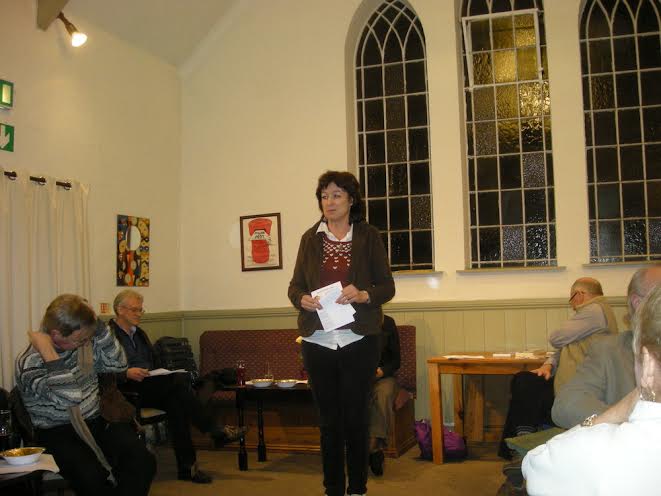
I was honoured to be asked to judge the 2013 H E Bates Short Story Competition, and last Friday 17th January I presented the prizes to the winners, which was both humbling (I wish I’d written some of those stories) and nerve racking (I had to do a short talk too). By the way, do these two gentlemen in the foreground and on the right of the photo look as though they are asleep? I’m sure I didn’t “hold forth” for that long!
So without further ado, here are the results and a brief summary of why I chose them.
Adult Section
1st prize: Last Tango in Space by Anne Corlett
2nd prize: Ancient Wing by Tracy Fells
3rd prize: Make Mine Mythical by Rosa Johnson
Under 18s
1st prize:Something In The Mist by Katie Bunting
Best short story written by a Northamptonshire writer:
Memories Through My Grandfather’s Eyes by Dave Martin
Why did I choose these stories? There were different reasons, but… they all had the X Factor. I’ve gone into a bit more detail below:
Memories Through my Grandfather’s Eyes was both warm and poignant and a lovely portrayal of an ordinary family.
Something In The Mistwas both gripping and full of insight and I was impressed by the author’s grasp of storytelling and structure. It was in male viewpoint and I was even more impressed when I discovered the author was female.
Make Mine Mythical was very funny and had brilliant characterisation and dialogue.
Ancient Wing was original, unusual, and beautifully written. Tracy managed to make me love the ‘at first’ unsympathetic main character – well done.
Last Tango In Space was fabulous. I cried when I read it. I cried again when Anne read it out on Friday. It was about an older couple on the first manned trip to Mars. Written in diary form, it was both amusing and deeply moving and ended with a fabulous universal truth. Thank you Anne for writing this. I wish I’d written it myself. I can give you no higher compliment.
Well done to all the winners of this incredibly hard to judge competition.
Thank you to everyone who entered.
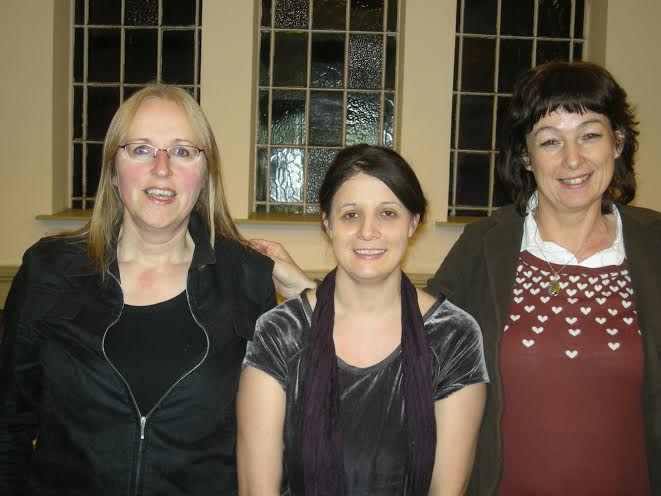
And here is Anne Corlett, winner of the H E Bates, with Morgen Bailey, Chair of the Northampton Writer’s Group, and myself.
If you’ve read this blog lately, you’ll know I’ve been doing the NaNoWriMo challenge, i.e. I signed up to write a 50,000 word novel during the month of November. Well, actually, I’m a nano rebel. I decided it would be more fun to write 50,000 words of short stories instead of writing a novel. So that’s what I’ve actually been doing. Here’s how it’s going so far.
I’m behind. It’s day 22, so I should have written 36,666 words. I have actually written 30,625 words. But hey, the good news is that I’ve written a whole pile of short stories. I’ve just had a bit of a tally. So far I’ve completed:
8 stories of approx 1000 words
2 of 3000 words
2 of 2500 words
(The rest of the words are beginnings and ideas that aren’t fully developed – might be interesting to come back to later)
Of the completed 8 short stories, 3 are edited, polished and submitted to mags. 1 is sold. It’s called the Lebkuchen Heart and Take a Break bought it for their New Year issue of Fiction Feast. Yippee. The other short ones are complete (ish) but need editing and polishing.
Both the 3000 word stories are also complete, but need editing and polishing.
1 of the 2500 word stories is polished, edited and submitted. The other I just finished writing today, so still needs an edit and polish.
But that still means I have 12 stories done so far up to at least draft stage.
Plus a pile of beginnings that I may go back to and develop.
Plus a pile of words that may have the nugget of a character or idea in them but that aren’t very structured.
So being behind on my word count isn’t a problem. I am thrilled. I never really expected to do this much. Especially as I’m in the throes of moving house so lots of packing and sorting out is going on.
It’s really inspiring and magical writing short stories every day without having to worry too much if they are a) any good and b) finished. Some of them I haven’t bothered finishing because they’re not working. Usually I’d struggle with that and waste loads of time flogging a dead horse – excuse the cliché. I’ve used all my original phrases in Nano stories 🙂
My top tip for doing Nano – or at least the thing that’s worked best for me, is to do it first thing. I don’t do anything else, not even check emails or go on Facebook or Twitter when I get to my computer. I just open up my Nanowrimo document, type the date, and start on today’s story. (I don’t – even if I really want to – edit yesterdays. Although I have let myself finish it if I didn’t manage to finish it the day before.)
It’s fantastic. Wonderfully Liberating.
Better get back to work. But I’d love to hear about other people’s Nanowrimo experiences. How are you getting on?
As I think I may have mentioned (once or twice) I now have two Writer’s Toolshed books in existence. Apparently there has been some confusion and a few people think there is still only one. So in the interests of setting the record straight, no, there really are two. And to prove it here they both are side by side. (in the same room!)
The Toolshed Collection
The Short Story Writer’s Toolshed is about writing short stories. And The Novel Writer’s Toolshed is – oddly enough – about writing novels – BUT The Novel Writer’s Toolshed is for writers who usually write short stories. It would actually be just as useful for novelists who fancy writing short stories instead because it’s specifically about the differences between the two forms. Phew! That was complicated. Hope it makes sense?
Tell you what – why don’t I reproduce the beginning of The Novel Writer’s Toolshed here – just in case anyone would like to check it out. Here it is:
Short Stories Versus Novels What’s the Difference?
Making the transition between writing short stories and writing your first novel isn’t as simple as you might think. Or at least it wasn’t for me. I’d had a fair amount of success with my short stories and I didn’t think that writing a novel would present too much of a problem. Surely it was just a short story with more words, more characters and more plot, wasn’t it?
No doubt, some of you are already sniggering at my naivety, and I was naïve. I made a lot of mistakes before I managed to write a publishable novel. Many of them were down to assumptions I had that simply weren’t true.
Yes, there are similarities between the short story and the novel and yes many of the techniques used for one can be transferred successfully to the other, but there are an awful lot of differences too.
The object of this book is to help you avoid some of the mistakes I made. Let’s take a quick look at some of the differences before we go into more detail about what’s in the toolshed, and hopefully this will make your transition a little smoother than mine was!
Length
This is probably the most obvious difference. Not many short stories are longer than about 5,000 words and even a short novel is at least ten times longer than that. The average length for a novel – if there is such a thing – is somewhere between about 50,000 and 120,000 words, depending on the type of novel and the publisher’s requirements.
Unlike a short story, which can be written and edited in a few days, a novel is going to take a substantial amount of time and work, which brings me on to my next point nicely.
Subject
What you write is always a fairly important question – time is our most precious commodity – but it’s not quite as important when you’re choosing what your next short story is about. After all, writing a short story takes significantly less time than writing a novel. We can afford to experiment a bit more. However, if you are going to spend a great deal of your precious time and energy on your novel – which you will if you’re going to do it properly – then it isn’t a bad idea to choose something you are passionate about. There are two main reasons for this:
1) If you are enjoying the writing, you are more likely to finish it.
2) If you don’t end up selling it then at least you will have enjoyed its creation and hence won’t feel your time would have been better spent doing cross stitch or playing golf!
I have no idea of the statistics on unfinished novels, but I bet there are thousands of them, languishing in desks or on computers across the country. They are started in a flash of inspiration and then the author finds they peter out at around 27,000 words, or perhaps worse, are finished in 27,000 words.
The percentage of first novels that are published is also very small. I have heard various figures quoted, but I won’t depress you with them. Besides, who really knows? A great many writers don’t even send their first novels out to publishers and a great many more are told by their publishers that although this is the eighth book they’ve actually written, it will be marketed as their debut novel.
This is not intended to put you off, far from it. Write your novel, keep an eye on the market, but primarily do it for the love of it.
My first novel, incidentally, which was written when I was about twenty, is somewhere in our loft, along with the other three novels I wrote before I managed to write one that was publishable!
Right then, let’s have a quick look at what’s on each of the shelves, whist keeping the differences between short story and novel in mind.
Planning, plotting, pace and timescale
A short story plot, by its nature, needs to be kept fairly simple. There isn’t enough room for it to be complicated. Generally a short story will tend to focus on a single event or theme.
If you are writing several thousand words you will need a much more developed plot, or perhaps one main plot and some interlinking subplots to sustain the length. Whereas a short story can follow a single idea, longer fiction tends to need more than one.
There isn’t room to hang around too much in a novel either, but you do need to have a very good control of pace. Contrary to what I thought when I started my novel writing journey, there is no room for waffle. Every word must still count. For many short story writers, pace is the hardest thing to adjust to when they begin to write longer fiction.
Setting
Setting in a novel is much more important than it is in a short story. In certain types of novels, for example regional sagas, it is equally as important as character. I will cover setting in detail under Shelf Two. All I want to say here is that you need to show setting through the eyes of your viewpoint characters – do not paste it into your novel in blocks or your reader will probably skip it!
Characters and viewpoint
A short story of a thousand words almost certainly won’t have more than two or three characters, one of whom will be the main character. There is a lot more room for characters in a novel although that doesn’t mean you should attempt to have a cast of hundreds! You will still need to know whose story it is – this is perhaps even more important in a novel than a short story as it’s much easier to lose focus – and all of your characters must be essential.
In a short story there is often only room for one viewpoint. In a novel there is room for more. Using the viewpoint of more than one character can add a great deal of depth to a novel if done with skill.
Dialogue
In a short story your reader will probably forgive you if your characters don’t have recognisable and individual voices. In a novel, they probably won’t. So character voice is one of the most important things to work on in longer fiction.
The first page and beyond
It’s vital to get your first page right. It is just as vital not to get stuck on it. I have a personal theory that it’s difficult to write the first page of your novel until you’ve written the rest of it. When I’m writing a short story I find the ending is the most difficult part. When I’m writing a novel I find it’s the opposite. It’s easy to write the last page, but very difficult to write the first.
Development, author voice and endings
Developing a story is fairly easy. The middle follows on naturally from the beginning – and so it is with novels, only it’s much easier to end up with a saggy middle in a novel – this can be solved by careful control of pace and also, I think by strong author voice. Thankfully, while ending a short story is tricky, bringing a novel to a satisfactory conclusion is much easier.
Structure and flashback
How will you structure your novel? Deciding before you begin to write can help you to plan it. Structure is a short story writer’s friend, but it’s a novelist’s best friend because there are far more options.
Your novel might have a prologue. It might be split into parts and it will probably have chapters. You’re not limited to flashback. You can use flash forward too! It is great fun to play with time in a novel.
Editing and revision
The main difference between editing and revision of the two forms is time. A short story can be edited in a morning or an afternoon. A novel is much more unwieldy. Using a plan can help.
The Title, the synopsis, the blurb
A good title is always important, but it’s more vital for a novel than a short story, as it’s one of your key selling points. A great title can sell a novel. A bad one can cause it to sink without trace.
Most novelists I have spoken to hate writing a synopsis. This is something you rarely have to do for short stories but which is an essential part of a novelist’s job. Or is it?
These days it’s probably more important to be able to write a blurb. Has the synopsis taken over from the blurb? What’s the difference? On Shelf Nine you’ll find some examples of both.
Finding an Agent – Do you need one?
The short answer is no. You have never needed an agent for short stories and you don’t necessarily need an agent for novels either, these days, but is it worth going alone? If you do want to look for an agent or a publisher, Shelf Ten, will show you how to proceed.
So there you have it – a little taster of what the Novel Writer’s Toolshed is about.
if you would like to know more, do please check out The Novel Writer’s Toolshed which is available for Kindle £1.88 and in paperback £4.99.
The Short Story Writer’s Toolshed is currently available for Kindle £1.88. Paperback coming very soon.
And if you just fancy a bit of light reading (pun intended), Ten Weeks to Target, my new novella is available as a Kindle book too for just £1.53 🙂
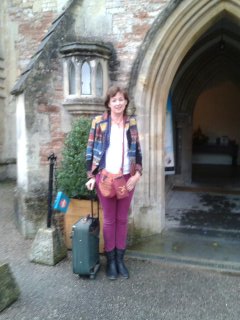
Me outside the Bishop's Palace where I'm about to teach
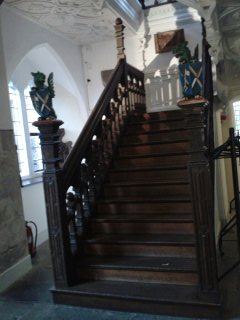
Just a little bit of feedback from me this week regarding the Wells Literature Festival where I did a workshop on Writing and Selling Short Stories on Sunday 13 October. I hadn’t realised I’d be teaching in the Bishop’s Palace. Wow! I felt quite intimidated when I saw the building. But on the other hand, what an inspiring place to work! Here are some pictures I thought you might like.
These are the stairs to my classroomAnd we're inside the palace - what an inspiring place to write
My group of 21 students wrote an opening paragraph and then read it out for feedback. I think they enjoyed it as much as I did. At four pm I gave out the prizes to the first, second and third prizewinners of the short story competition. Well, actually I didn’t, as none of them were there. So if you did enter, and you didn’t go to the prizegiving you may well be in for a lovely surprise. Do check out the results which should be on the website here any day now. My lips are sealed until the festival has updated its website.
And in the meantime, thanks to the students who came to my workshop. I hope to see you all in print very soon.
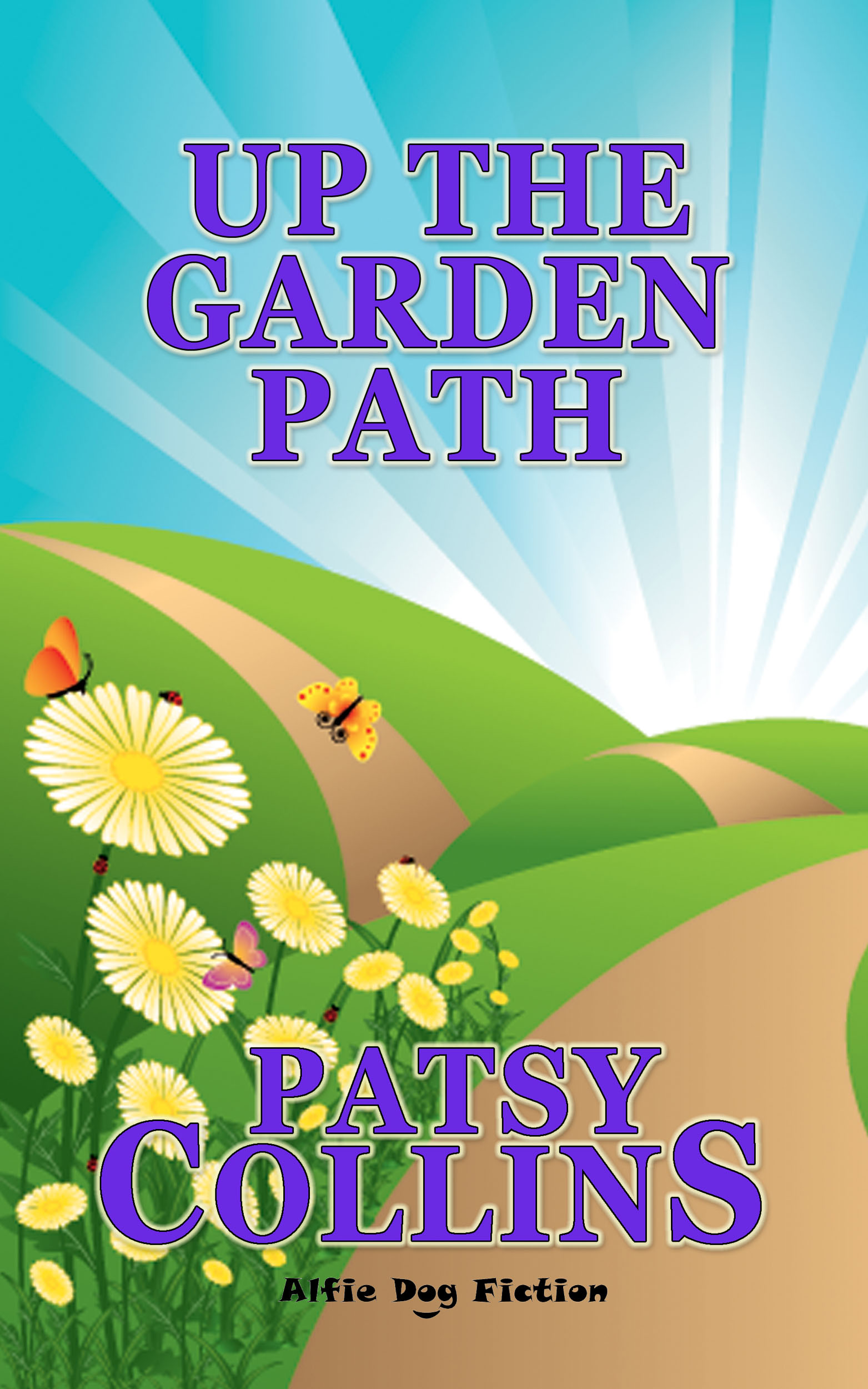
This week on the Wednesday Writing Spot, I am delighted to welcome writer, Patsy Collins, who is talking about where she gets her ideas from and her fabulous new short story collection, which is called Up The Garden Path. It’s lovely to have you here, Patsy. Now it’s over to you…
As writers we are often asked where we get our ideas from. It seems such a reasonable question but it’s very hard to give a satisfactory answer. Each writer will get their inspiration in a different way to that of their colleagues and they’ll probably draw on a number of resources. Ideas are everywhere you see. That’s both good and bad. We don’t have to wait for the ideas shop to open, but those little story sparks don’t come neatly labelled ‘romance novel suggestion’ or ‘ghost story premise’ so we need to train ourselves to spot them.
My new short story collection contains twenty four short stories and each is the result of a different stimulus. It’s a bit like picking wild mushrooms, really. If you want nice, safe mushrooms you need to know what they look like or you’ll end up with something toxic, or hallucinogenic or bitter. Of course if you actually want to poison someone you’ll need to be on the lookout for something different (pale gills and skinny stalks are a good sign in this case). ‘Write what you know’ is good advice. That’s what I did for ‘A Piece of Pink Ribbon’ which is set on a farm and ‘Coming Home’ which is about separation when someone is away at sea. It also explains why all the stories in the collection have a horticultural theme – I’m nearly as keen on gardening as eating cake. Real life events can be a great source of story ideas, but the truth often needs adapting. Weirdly when we write something strange, funny or touching that really happened it often doesn’t feel believable. ‘Watchdog’ is based on a real event (although not one which happened to me) but to make it work I had to change reality. Whenever I come across an unusual name eg ‘Mrs Dalrymple’ overhear an interesting comment such as ‘Your Granddad is Stuck Up a Tree Again’ or want revenge on an annoying boss (‘Blooming Talent’) I make a note in a computer file. Sometimes the prompt is as simple as the smell of ‘Strawberry Jam’ and at others it’s as complex as family politics (I’m admitting nothing!). It doesn’t matter where the ideas come from, it’s what you do with them that counts. I hope you like what I’ve done with those which resulted in ‘Up the Garden Path’. The book is available here – or here.