Publishers and agents like to categorise novels into genre. Partly so they know which shelf to put your book on at the library/bookshop. Genre refers to the type of story you’re writing. Here are some of the most popular genres and some very ballpark figures on how long they are.
Romance: quite a broad spectrum, ranging from Mills & Boon category romance (Approx 55,000 words) to more mainstream romance. (Approx 90,000).
Historical: Period stories. (Can be 120,000 plus).
Sagas: Multigenerational stories. (Can be 120,000 plus).
Fantasy/Sci fi: Includes other worlds, past, present and future. (Can be 120,000 plus).
Timeslip: (Can be 120,000 plus).
Erotica: Includes all genres, from mainstream to niche. (55,000 plus).
Literary: (practically any length – depending on publisher).
Commercial Women’s Fiction: a catch all for anything that doesn’t come under another category. (80,000 plus).
I should also mention children’s and YA which isn’t a genre exactly but is a law unto itself. Length depends on age group and publisher.
The above list is not exhaustive. It’s simply meant as a very general guide. Publishers will usually state what lengths and genre types they are interested in receiving.
Digital publishing means that there is a great deal more flexibility than there used to be because the cost of printing doesn’t govern the length of a novel. Many publishers today will consider novels from 55,000 upwards and this was once thought to be too short (except for category romance).
It’s usually easier to sell a novel that fits into a genre because publishers see the market as being more defined. Readers of sci-fi like to read sci-fi. Readers of crime like to read crime. However there are, of course, elements of romance in most of the other categories. It’s hard to avoid as it’s so much a part of the human condition!
A true cross genre novel, for example, a psychological thriller cross fantasy tends to be much harder to sell.
Also, interestingly, although publishers don’t want to buy them, it’s very often a cross genre novel that will become an out of left field bestseller. Fifty Shades of Grey was (in my opinion) category romance plus bondage! Jonathan Strange & Mr Norrell by Susanna Clarke was historical plus magic/fantasy.
As writers it’s probably better to know our genre and try to stay somewhere within it. However, I also think that we should write what we feel most passionate about and not follow too many rules. Phew! Did I mention it was complicated!
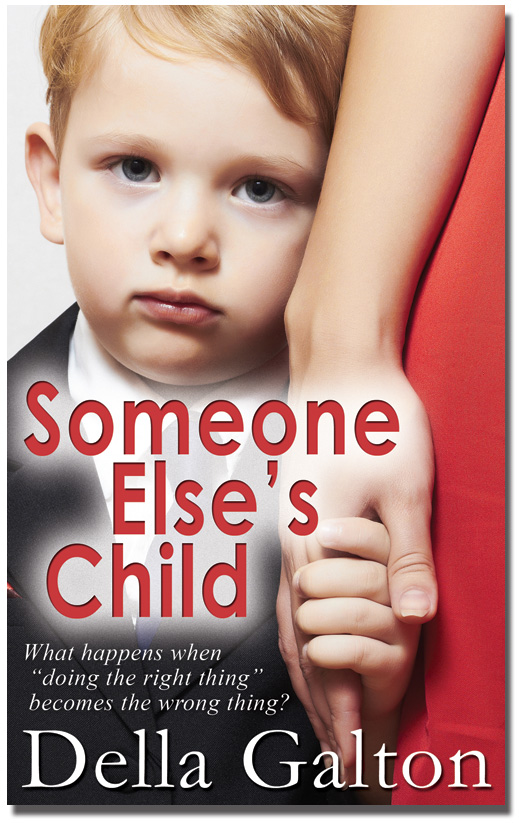
My new novella, Someone Else’s Child, recently hit the virtual shelves. Here’s the first chapter just in case you fancy a read. I like this little book – it was one of the first longer stories I ever wrote and there is a lot of me in it. It’s about friendship and about upbringings and about loving children that aren’t yours. And I cried when I wrote parts of it so I think it’s pretty emotional. Please do let me know what you think.
Chapter One
Jo has been my best friend for as long as I can remember.
We have totally different backgrounds, Jo was brought up in a children’s home and my mother had a chain of hotels, but somehow we clicked right from the beginning. Perhaps, because for different reasons, we both felt isolated as children. Jo didn’t have any parents, and mine were absent most of the time. My mother, because the only thing she was truly passionate about was her business, and my father because he couldn’t cope with this fact and had left when I was small to marry a more ‘ordinary’ woman.
Jo and I aren’t alike in looks either. Jo is olive skinned, dark haired and curvy and I’ve always been what she calls a skinny blonde. I’m not skinny – well not these days anyway – and my hair is the kind of white blond that no one could envy because it comes with pale eyelashes and skin that burns at the first hint of sunlight. Looks-wise, I’d swap with Jo any day.
One of my most vivid childhood memories is of playing with Jo on the grass verge outside the Barrington Hall Hotel, which was where I lived at the time. The hotel was at the end of an unmade road, but only cars visiting us ever used it, and I was allowed to play out there unsupervised. My mother wouldn’t have been too happy if she’d known who I was playing with – she didn’t approve of Jo – but she wasn’t likely to find out, she was busy doing one of the endless things she did in the hotel.
Anyway, the sun was shining and Jo and I were stretched out on our backs. Jo was chewing a blade of grass, her face thoughtful, but as I glanced at her, she spat it out and sat up.
“So, are we going to do this blood sister thing then, Lainey? Did you get the stuff?”
I was really Elaine, and she was really Joanne – but those names were for other people. To each other we’d always been Lainey and Jo.
We’d been planning to become blood sisters for a while, but now the day was finally here I was a little bit scared. Not that I was going to admit to this, of course.
I nodded and sat up too and fished in my pocket. “I didn’t know whether scissors would work, so I got some of Mum’s needles from the sewing box as well.” I unwrapped the nail scissors and then more carefully a little pack of needles from the tissue paper. “Otherwise I could get a knife from the kitchen drawer.”
“No, the needles should work.” Jo’s eyes were alight with expectation. “Get one out. Don’t drop it.”
“I’m not going to drop it.” I slid one out and held it between my finger and thumb. I could hardly feel it, but it glinted silver in the morning sun. “Do you think it’ll hurt?” I stabbed it cautiously into the back of my hand.
“Nah. Not like that. You have to prick your thumb. That’s what they did in my book. Give it here.”
I handed it over obediently, watching with apprehension as Jo stabbed her thumb. She had to do it a couple of times because at first the skin just broke without bleeding, but then finally she got a drop of blood on the fleshy bit.
“Did it hurt much?” I asked, doing my best to sound casual.
“Nah. Come on. Hurry up and do yours. I’ll squeeze a bit more blood out.” I took the needle carefully. There was a trembly feeling in the pit of my stomach. This had been Jo’s idea, a way of proving that we were best friends who would never be separated, blood sisters for ever and ever. Not that I had to prove it, I knew it anyway, but it had been important to Jo so I’d gone along with it.
“Are you sure it doesn’t hurt?”
“Just get on with it. And hurry up. I’m bleeding to death waiting for you.”
We both giggled and it broke the tension. I pricked my thumb. It stung, but aware of her gaze, I pushed the needle a bit harder. A red bead appeared and for a moment I couldn’t take my eyes off it. My stomach was crunching and churning and the sun was hot on the back of my neck and I thought I might be sick.
“Right then.” Jo wriggled a bit closer and we pressed thumbs together. “Blood sisters for ever.”
“Friends for ever.” We gazed into each other’s eyes. “Even when we grow up and have kids of our own, we’ll still be best friends, won’t we?”
Jo nodded solemnly. “No one will ever come between us.”
I nodded too. “Never, ever, ever.”
If you’d like to read on for less than the price of a cup of coffee please clickhere.Thank you.
As I think I may have mentioned (once or twice) I now have two Writer’s Toolshed books in existence. Apparently there has been some confusion and a few people think there is still only one. So in the interests of setting the record straight, no, there really are two. And to prove it here they both are side by side. (in the same room!)
The Toolshed Collection
The Short Story Writer’s Toolshed is about writing short stories. And The Novel Writer’s Toolshed is – oddly enough – about writing novels – BUT The Novel Writer’s Toolshed is for writers who usually write short stories. It would actually be just as useful for novelists who fancy writing short stories instead because it’s specifically about the differences between the two forms. Phew! That was complicated. Hope it makes sense?
Tell you what – why don’t I reproduce the beginning of The Novel Writer’s Toolshed here – just in case anyone would like to check it out. Here it is:
Short Stories Versus Novels What’s the Difference?
Making the transition between writing short stories and writing your first novel isn’t as simple as you might think. Or at least it wasn’t for me. I’d had a fair amount of success with my short stories and I didn’t think that writing a novel would present too much of a problem. Surely it was just a short story with more words, more characters and more plot, wasn’t it?
No doubt, some of you are already sniggering at my naivety, and I was naïve. I made a lot of mistakes before I managed to write a publishable novel. Many of them were down to assumptions I had that simply weren’t true.
Yes, there are similarities between the short story and the novel and yes many of the techniques used for one can be transferred successfully to the other, but there are an awful lot of differences too.
The object of this book is to help you avoid some of the mistakes I made. Let’s take a quick look at some of the differences before we go into more detail about what’s in the toolshed, and hopefully this will make your transition a little smoother than mine was!
Length
This is probably the most obvious difference. Not many short stories are longer than about 5,000 words and even a short novel is at least ten times longer than that. The average length for a novel – if there is such a thing – is somewhere between about 50,000 and 120,000 words, depending on the type of novel and the publisher’s requirements.
Unlike a short story, which can be written and edited in a few days, a novel is going to take a substantial amount of time and work, which brings me on to my next point nicely.
Subject
What you write is always a fairly important question – time is our most precious commodity – but it’s not quite as important when you’re choosing what your next short story is about. After all, writing a short story takes significantly less time than writing a novel. We can afford to experiment a bit more. However, if you are going to spend a great deal of your precious time and energy on your novel – which you will if you’re going to do it properly – then it isn’t a bad idea to choose something you are passionate about. There are two main reasons for this:
1) If you are enjoying the writing, you are more likely to finish it.
2) If you don’t end up selling it then at least you will have enjoyed its creation and hence won’t feel your time would have been better spent doing cross stitch or playing golf!
I have no idea of the statistics on unfinished novels, but I bet there are thousands of them, languishing in desks or on computers across the country. They are started in a flash of inspiration and then the author finds they peter out at around 27,000 words, or perhaps worse, are finished in 27,000 words.
The percentage of first novels that are published is also very small. I have heard various figures quoted, but I won’t depress you with them. Besides, who really knows? A great many writers don’t even send their first novels out to publishers and a great many more are told by their publishers that although this is the eighth book they’ve actually written, it will be marketed as their debut novel.
This is not intended to put you off, far from it. Write your novel, keep an eye on the market, but primarily do it for the love of it.
My first novel, incidentally, which was written when I was about twenty, is somewhere in our loft, along with the other three novels I wrote before I managed to write one that was publishable!
Right then, let’s have a quick look at what’s on each of the shelves, whist keeping the differences between short story and novel in mind.
Planning, plotting, pace and timescale
A short story plot, by its nature, needs to be kept fairly simple. There isn’t enough room for it to be complicated. Generally a short story will tend to focus on a single event or theme.
If you are writing several thousand words you will need a much more developed plot, or perhaps one main plot and some interlinking subplots to sustain the length. Whereas a short story can follow a single idea, longer fiction tends to need more than one.
There isn’t room to hang around too much in a novel either, but you do need to have a very good control of pace. Contrary to what I thought when I started my novel writing journey, there is no room for waffle. Every word must still count. For many short story writers, pace is the hardest thing to adjust to when they begin to write longer fiction.
Setting
Setting in a novel is much more important than it is in a short story. In certain types of novels, for example regional sagas, it is equally as important as character. I will cover setting in detail under Shelf Two. All I want to say here is that you need to show setting through the eyes of your viewpoint characters – do not paste it into your novel in blocks or your reader will probably skip it!
Characters and viewpoint
A short story of a thousand words almost certainly won’t have more than two or three characters, one of whom will be the main character. There is a lot more room for characters in a novel although that doesn’t mean you should attempt to have a cast of hundreds! You will still need to know whose story it is – this is perhaps even more important in a novel than a short story as it’s much easier to lose focus – and all of your characters must be essential.
In a short story there is often only room for one viewpoint. In a novel there is room for more. Using the viewpoint of more than one character can add a great deal of depth to a novel if done with skill.
Dialogue
In a short story your reader will probably forgive you if your characters don’t have recognisable and individual voices. In a novel, they probably won’t. So character voice is one of the most important things to work on in longer fiction.
The first page and beyond
It’s vital to get your first page right. It is just as vital not to get stuck on it. I have a personal theory that it’s difficult to write the first page of your novel until you’ve written the rest of it. When I’m writing a short story I find the ending is the most difficult part. When I’m writing a novel I find it’s the opposite. It’s easy to write the last page, but very difficult to write the first.
Development, author voice and endings
Developing a story is fairly easy. The middle follows on naturally from the beginning – and so it is with novels, only it’s much easier to end up with a saggy middle in a novel – this can be solved by careful control of pace and also, I think by strong author voice. Thankfully, while ending a short story is tricky, bringing a novel to a satisfactory conclusion is much easier.
Structure and flashback
How will you structure your novel? Deciding before you begin to write can help you to plan it. Structure is a short story writer’s friend, but it’s a novelist’s best friend because there are far more options.
Your novel might have a prologue. It might be split into parts and it will probably have chapters. You’re not limited to flashback. You can use flash forward too! It is great fun to play with time in a novel.
Editing and revision
The main difference between editing and revision of the two forms is time. A short story can be edited in a morning or an afternoon. A novel is much more unwieldy. Using a plan can help.
The Title, the synopsis, the blurb
A good title is always important, but it’s more vital for a novel than a short story, as it’s one of your key selling points. A great title can sell a novel. A bad one can cause it to sink without trace.
Most novelists I have spoken to hate writing a synopsis. This is something you rarely have to do for short stories but which is an essential part of a novelist’s job. Or is it?
These days it’s probably more important to be able to write a blurb. Has the synopsis taken over from the blurb? What’s the difference? On Shelf Nine you’ll find some examples of both.
Finding an Agent – Do you need one?
The short answer is no. You have never needed an agent for short stories and you don’t necessarily need an agent for novels either, these days, but is it worth going alone? If you do want to look for an agent or a publisher, Shelf Ten, will show you how to proceed.
So there you have it – a little taster of what the Novel Writer’s Toolshed is about.
if you would like to know more, do please check out The Novel Writer’s Toolshed which is available for Kindle £1.88 and in paperback £4.99.
The Short Story Writer’s Toolshed is currently available for Kindle £1.88. Paperback coming very soon.
And if you just fancy a bit of light reading (pun intended), Ten Weeks to Target, my new novella is available as a Kindle book too for just £1.53 🙂